By Jose E. Navarro, The Navarro Report
SAN DIEGO — A cease-fire signed with hand-shakes and a Truth Social victory lap is now being tested by the oldest instrument in geopolitics: a closed waterway.
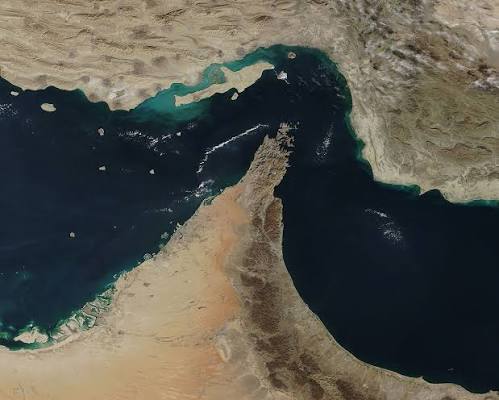
Iran shut the Strait of Hormuz on Saturday after Israeli forces struck targets in Lebanon, a move Tehran says was provoked but one that directly violates the U.S.-Iran memorandum of understanding signed only days earlier. The strait carries roughly a fifth of the world’s oil supply through a channel barely two miles wide at its narrowest point, and its closure is precisely the kind of escalation the new agreement was designed to prevent.
President Trump, never one to let an ultimatum go unmatched, responded with one of his own: reopen the strait, or the United States will impose tolls on a waterway he says American power has kept free for decades. “Services rendered as the Guardian Angel to the countries of the Middle East,” he wrote on Truth Social Saturday — a framing that treats decades of U.S. naval presence in the Gulf as an unpaid invoice now coming due. The threat is notable because the memorandum itself calls for 60 days of toll-free passage while negotiators work toward a wider deal.
That wider deal looks shakier than it did a week ago. The memorandum, signed Wednesday, set the stage for direct bilateral talks meant to begin Friday in Switzerland. Those talks were postponed amid the renewed fighting between Israel and Hezbollah in Lebanon. Three diplomats briefed on the matter told CBS News that Israel and Hezbollah had separately agreed to a cease-fire of their own, set to begin Friday morning — a cease-fire that, on the evidence of Saturday’s strikes, did not hold or did not apply to the targets Israel chose to hit.
Lower-level “technical” talks between U.S. and Iranian teams are now set to begin Sunday at the Bürgenstock Resort in Switzerland, with Pakistan and Qatar serving as mediators. Pakistan’s foreign ministry confirmed the session will go forward despite the postponement of the higher-stakes negotiations. The resort, perched above Lake Lucerne, has been closed to the public since Wednesday and is not expected to reopen until midweek.
The money question hangs over all of it. The memorandum references a reconstruction plan for Iran worth at least $300 billion, to be developed jointly by the U.S. and regional partners — but the release of any frozen Iranian assets remains a subject for the now-delayed next phase of talks. Trump has been explicit that none of that money moves yet. “Iran would get no money, not ten cents!” he wrote Friday, a line aimed as much at critics in Washington as at Tehran.
Iran’s side of the messaging has its own complications. A statement attributed to Supreme Leader Mojtaba Khamenei — who inherited the position after his father was killed in the opening day of joint U.S.-Israeli strikes — framed the agreement as something Washington pursued “out of desperation,” while confirming that Tehran has accepted the deal’s terms for now. Khamenei has not appeared publicly since assuming the role, a detail that continues to shape outside assessments of how stable the arrangement in Tehran actually is.
There is one data point suggesting the underlying machinery of the deal is still functioning even as the politics fray: shipping. On June 18, tracking firm AXSMarine recorded 25 verified commercial vessel crossings through the strait — the highest single-day count since April 18, and more than five times the daily average seen in early June. Markets, in other words, are behaving as though the strait will reopen, even while the diplomats argue about who closed it and why.
Why it matters: A fifth of the world’s oil moves through Hormuz. Every disruption there shows up within days at gas pumps from San Diego to Sacramento, and every delay in the broader U.S.-Iran talks extends the window in which a single strike, in Lebanon or elsewhere, can unravel a fragile agreement before its ink is fully dry.
— Jose E. Navarro, The Navarro Report / Human-Directed AI Journalism: Research, analysis, and editorial direction by the author. Drafted in partnership with Claude AI (Anthropic).