San Diego County Affairs — July 12, 2026
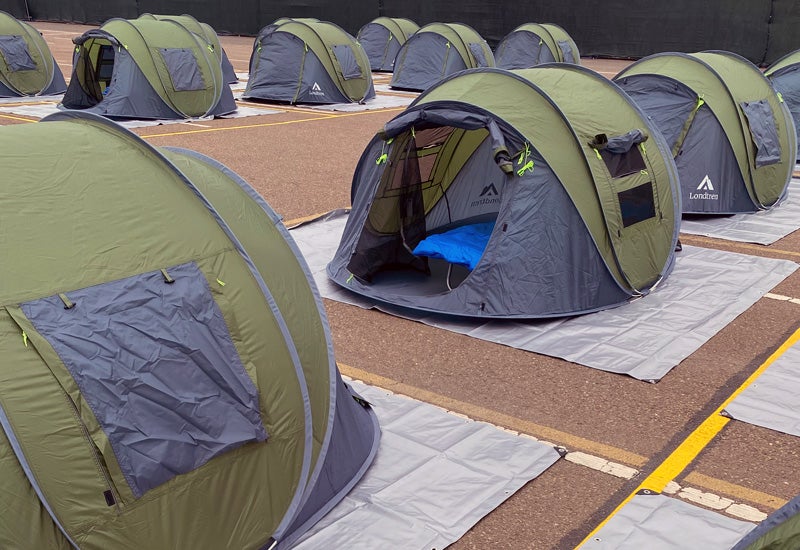
Tim Allen was 56 years old, a twin, and by his brother’s account a man looking forward to a collector card show. He was found dead in his tent Monday at the city’s O Lot safe sleeping site, next to the Naval Medical Center, becoming the 19th person to die at one of San Diego’s two safe sleeping locations since the program opened in 2023.
“The city let my brother down,” said James Allen, Tim’s fraternal twin, speaking from Palm Springs after learning of the death. He said the two had spoken Friday and Tim was in good spirits, making plans for the upcoming show. Three days later he was gone.
The death toll has climbed steadily and publicly since ABC 10News investigative reporter Austin Grabish first documented a dozen deaths at the sites roughly a year ago. That original count grew to 13 within weeks, and now sits at 19 — a pace that outstrips the growth in the sites’ capacity or funding, and one the city has yet to explain with any comprehensive accounting of cause of death across cases.
The city’s response Monday was the same one it has given for each of the preceding deaths. “The health, safety, and well-being of individuals participating in the City’s Safe Sleeping program remain our highest priority,” said city spokesman Matt Hoffman, directing further questions about causes of death to the County Medical Examiner. That office has previously attributed at least one death to a body left undiscovered for days — a man found only after staff conducted what the Medical Examiner’s report described as a “foul odor check.”
Tim Allen’s death is not an isolated data point in a system operating as designed; it’s the latest entry in a federal lawsuit already working its way through court. Civil rights attorney Ann Menasche, who represented Allen in that case, said the litigation continues on behalf of the broader population still living at the sites. “I hope that in his name we can get justice for everybody else that’s still living,” she said. The suit, filed with claims covering unsafe conditions, inadequate security, and structural neglect at the sites, names the city, Dreams for Change, and Downtown San Diego Partnership as defendants.
For a nonprofit and civic finance audience, the number that should draw scrutiny isn’t just 19 deaths — it’s the absence of any published mortality-rate benchmark the city is holding itself to, and no public accounting of what portion of the sites’ operating budget goes to on-site medical monitoring versus tents, security contracts, and administrative overhead. San Diego has never released a per-site cost breakdown that would let the public judge whether death rates at O Lot and B Lot are simply the unavoidable consequence of serving a medically fragile unhoused population, or whether they reflect underfunded oversight relative to comparable programs in other California counties.
That question carries added weight this year. San Diego is spending heavily to present itself as a world-class host city for the 2026 FIFA World Cup, with hospitality investment and civic marketing dollars flowing at a pace the city’s own $120 million budget shortfall makes hard to reconcile. Whether safe sleeping site oversight has kept pace with that spending, or been squeezed by it, is a question no city official has answered on the record.
The county medical examiner’s office has not released a public breakdown of causes of death across all 19 cases. Menasche’s federal lawsuit remains pending.
Residents at the sites have said as much in their own words for well over a year now. When ABC 10News first reported a dozen deaths, one man staying at a Safe Sleeping site put the comparison to the street bluntly: he said he believed conditions outside the program were, in his words, better than inside it. Others have described mold in early tent stock, replacement tents deteriorating under sun exposure, and complaints about rodents and inadequate security that formed the basis of the pending federal lawsuit. The city has consistently disputed the severity of those conditions while declining to release the kind of independent, site-by-site audit that would let the public evaluate the claims directly.
None of that erases the fact that the Safe Sleeping program exists because the alternative — unsheltered homelessness on San Diego’s streets — carries its own well-documented mortality risk. The honest accounting isn’t a choice between a flawed program and a perfect one; it’s a question of whether 19 deaths in roughly three years represents an acceptable cost of an imperfect but necessary intervention, or a signal that oversight hasn’t kept pace with the program’s growth. The city hasn’t offered its own answer to that question in public. Until it does, that number will keep climbing, and the story will keep getting written one grieving family at a time.
— Jose E. Navarro, The Navarro Report / Human-Directed AI Journalism: Research, analysis, and editorial direction by the author. Drafted in partnership with Claude AI (Anthropic).