
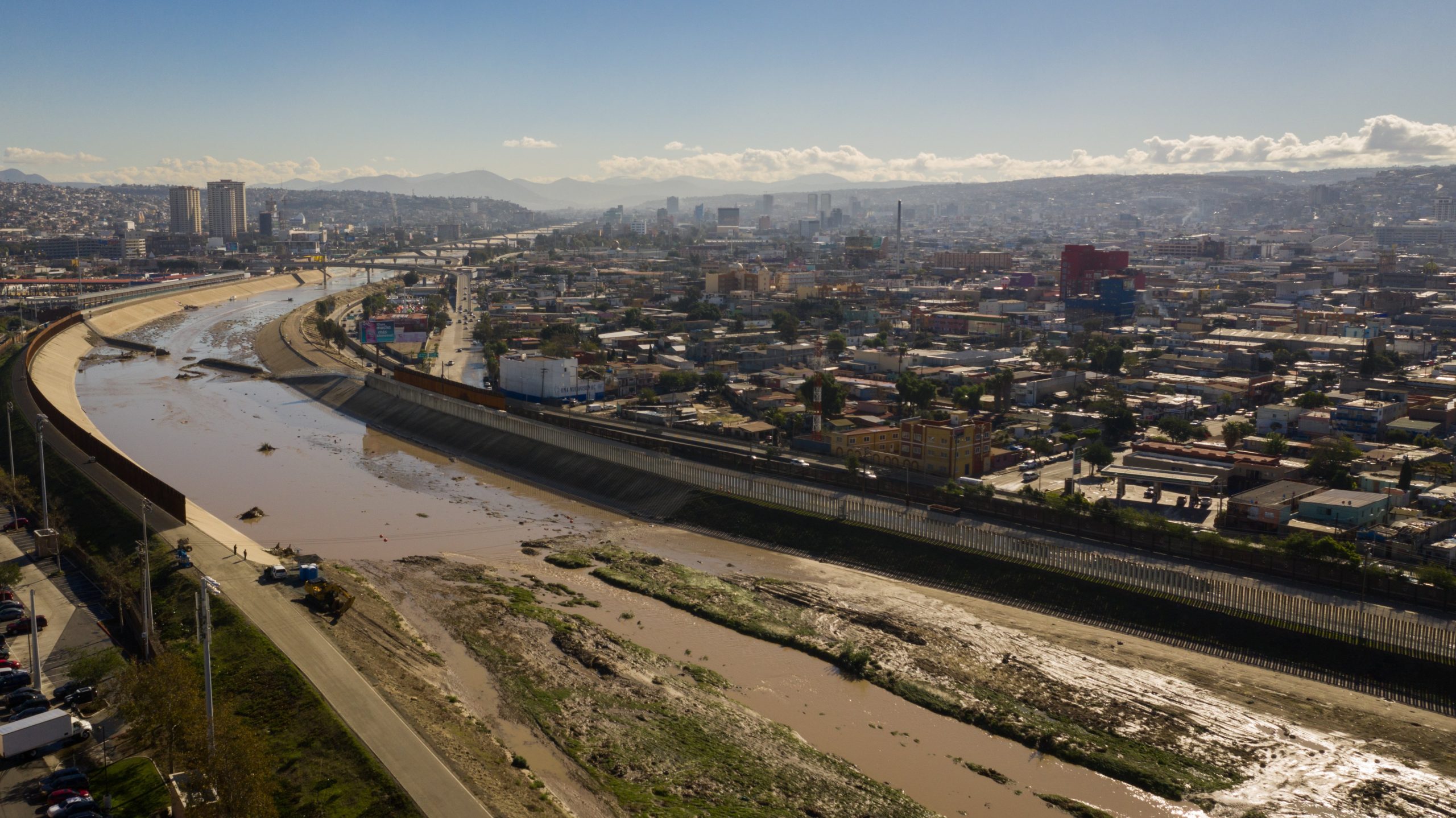
A press release, a media frenzy, and the communities still breathing toxic air while waiting for a real fix.
On June 11, Governor Gavin Newsom issued a press release with the kind of headline that moves fast on social media: California was sending $46 million to address the Tijuana River sewage crisis. Media outlets nationwide ran with it. The story made sense — the crisis is real, the communities affected are exhausted, and the governor has been clashing publicly with the Trump administration over who bears responsibility for the most enduring public health emergency on the U.S.-Mexico border.
There was just one problem. The $46 million was not going to the Tijuana River. Not yet. Not necessarily ever.
What Newsom actually announced was that the State Water Resources Control Board was opening a competitive grant application process — funded through Proposition 4, a $10 billion climate bond California voters approved in 2024. That pool of money is available to projects addressing contamination in cross-border rivers. The Tijuana River is one of them. So is the New River, a severely polluted waterway that flows north through the city of Calexico and empties into the Salton Sea in Imperial Valley. Communities along both rivers have been competing for this money for months. No one has received a dollar yet.
Voice of San Diego, the region’s most dogged accountability outlet, caught the discrepancy and reported it plainly: “Newsom was merely announcing that the State Water Resources Control Board was now accepting applications for a piece of a $46 million pot.” The framing in Newsom’s press release, which prominently featured the Tijuana River and included an implicit dig at the Trump administration’s inaction, generated enormous coverage. The clarification barely registered.
This matters, because the people living near the Tijuana River have been waiting — and suffering — for a very long time. Since 2018, more than 100 billion gallons of raw sewage, industrial chemicals, and trash have flowed into the river from Tijuana, crossing the U.S.-Mexico border and moving through South County communities before emptying into the Pacific Ocean. Imperial Beach has seen over 1,500 consecutive days of beach closures. The earliest complaints about sewage reaching Imperial Beach date to 1933, when Tijuana’s population was 14,000. Today that population is 2.3 million. The crisis did not sneak up on anyone.
The health data has grown harder to ignore. A 2025 study published in the journal Science found that nighttime hydrogen sulfide levels near the Saturn Boulevard crossing — a turbulent “hot spot” where contaminated water aersolizes as it rushes through culverts — peaked at 4,500 parts per billion. California’s one-hour ambient air quality standard is 30 ppb. Typical urban levels are below 1 ppb. Workers near the river — lifeguards, park rangers, outdoor laborers — report headaches, fatigue, nausea, and bloody noses. San Diego County has distributed 12,000 air purifiers to households nearby. They are raising money for more, because health officials recommend one per bedroom and many families in these communities live in multi-generational homes.
Children are getting sick. “When it’s really bad, I feel like I can taste it,” said Nestor resident Bobbi Otero, who lives near the Tijuana River Valley. “You’re coming down the street a half mile away, you’ve got your windows down because it’s a beautiful San Diego day, and there’s that odor.” Sharp Healthcare’s president and CEO Chris Howard has called it plainly what it is: “a public health issue,” with communities in the South Bay dealing with “beach closures, foul odors, and exposure to harmful bacteria and toxins.”
South County is one of San Diego’s most heavily Latino regions. The people most exposed to hydrogen sulfide, raw sewage, and chemical runoff are disproportionately low-income immigrants and working families who did not choose this crisis and have limited political power to end it. The Sierra Club has described the situation in stark terms: “There is nowhere else in the United States of America that you would allow millions of gallons of sewage to flow through.”
California has allocated roughly $38 million in Tijuana River improvements since 2019 — money that has funded trash booms, sediment basins, and restoration projects. Those investments are real, and the people running them deserve credit. But the scale of the problem dwarfs the response. Seventy-five percent of Tijuana’s wastewater network needs urgent repairs. Half of its pump stations are failing. The federal government, which operates the South Bay International Wastewater Treatment Plant in San Ysidro and holds treaty-based responsibility for treating cross-border flows, has not delivered a permanent fix. EPA Administrator Lee Zeldin visited San Diego in February and said a solution would take “a couple of years.” That answer has not satisfied anyone who lives downwind of Saturn Boulevard.
Newsom’s June 11 announcement included a pointed call on the Trump administration to “honor its commitments.” That framing is legitimate — the federal government has been slow, and the political pressure matters. But announcing a grant application process as if it were a check already written is a different thing. And the communities that breathed toxic air this week, last week, and every week for years deserve to know the difference.
The $46 million, if and when it is awarded to Tijuana River projects, will still fall short of what’s needed. San Diego County alone is requesting at least $25 million just to address the Saturn Boulevard hot spot. The county also wants the entire $46 million directed its way — a request that puts it in direct competition with Imperial Valley communities dealing with the New River, whose contamination is arguably just as severe and even longer-running.
A press release is not a solution. The people of South County have been waiting 93 years for one.
— Jose E. Navarro, The Navarro Report / Human-Directed AI Journalism: Research, analysis, and editorial direction by the author. Drafted in partnership with Claude AI (Anthropic).