
ROME — World Affairs / Sports | The Navarro Report
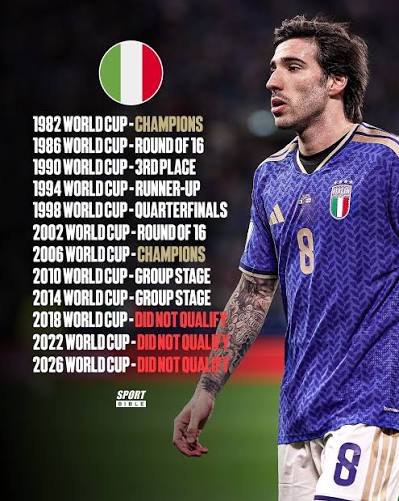
When Roberto Baggio quietly resigned from the Italian Football Federation in 2013, warning that his 900-page reform report had “remained a dead letter,” few imagined Italy would still be searching for answers 13 years later. But after Italy’s penalty-shootout loss to Bosnia and Herzegovina on March 31 sealed a third consecutive World Cup absence, the conversation has moved beyond one man’s ignored proposals to two structural issues Italian football has been slower than its rivals to confront: who gets to wear the blue jersey, and who gets paid to develop them.
France, Spain, Germany and the Netherlands have each, in different ways, turned demographic change into a competitive advantage. Sixteen of France’s 26-man 2026 World Cup squad were born abroad or have parents who migrated to the country, with family roots spanning Africa, the Caribbean and beyond. The French federation’s approach prioritizes academy development over birthplace, a system that helped fold Kylian Mbappé, Ousmane Dembélé and dozens of others born to immigrant families into the national fabric of Les Bleus. That model has not been free of tension; French filmmaker Rokhaya Diallo has argued that immigrant-origin players are only fully embraced when they succeed spectacularly, saying of French society, “you have to be exceptional to be seen.” Still, the pipeline itself has kept France near the top of world football for a decade.
Italy has taken a different legal path. Citizenship remains governed overwhelmingly by jus sanguinis, or right of blood, rather than birthplace, and a 2025 reform tightened the descent-based pathway further while leaving Italy’s already narrow ius soli provisions largely untouched. Children born in Italy to immigrant parents can apply for citizenship only after turning 18, and only if they have lived in the country continuously since birth — a conditional process critics say excludes thousands of young people who grew up entirely within the Italian school and youth football systems. One analysis of the law’s contradictions noted that an Argentine national with a Sicilian great-grandparent can often gain an Italian passport faster than “a Moroccan-born individual who has lived in Italy their entire life.” Proposals for a more inclusive ius scholae pathway, which would grant citizenship to children who complete a set number of years in Italian schools, have circulated in Parliament for years without passing.
The squad that lost to Bosnia illustrates that contradiction almost perfectly, in the persons of two Azzurri strikers who started that night. Moise Kean was born in Vercelli, Italy, in 2000 to parents who had emigrated from Ivory Coast a decade earlier; he grew up in Asti, played his first football at a parish oratory after school, and moved through Juventus’s youth academy before ever pulling on the senior national team shirt. His path, though ultimately successful, ran through exactly the kind of conditional, residency-based citizenship process reformers want to make more automatic for children like him. His strike partner that night, Mateo Retegui, took the opposite route entirely. Born and raised in San Fernando, outside Buenos Aires, to a prominent Argentine field hockey family, Retegui came up through the River Plate and Boca Juniors academies and represented Argentina at youth level. He qualifies for Italy purely through jus sanguinis — a maternal grandfather, Angelo Dimarco, who emigrated to Argentina from Canicattì, Sicily, decades earlier. When he was first called into the Italy squad in 2023, reporting at the time noted he had never lived in the country and did not speak Italian.
That path has a name in Italian football history: oriundo, from the Latin for “originating,” a term applied for nearly a century to South American players of distant Italian descent recruited onto the national team, from Omar Sívori and José Altafini in earlier eras to Mauro Camoranesi more recently. Roberto Mancini, the Italy coach who first called up Retegui, had once argued against the practice. “Players who are born in Italy should play for the national team,” he had said in earlier years, according to an interview with The Times. By 2023 Mancini had reversed course, telling reporters that every major national team now draws on players born or raised abroad and that Italy could no longer afford to be an exception. The reversal underscores the paradox at the heart of Italy’s system: a bloodline four generations removed and never physically resided in Italy is, under current law, a more direct route to the national team than being born and raised in the country to non-Italian parents. Reform advocates argue that fixing the imbalance would not mean closing the oriundo pathway that has produced players like Retegui, but opening a parallel, faster one for Italy’s own homegrown children of immigrants.
Former FIGC president Gabriele Gravina pointed to a related, if narrower, problem on his way out the door: only about a third of players appearing in Serie A each week are even eligible to represent Italy, whether due to citizenship status or dual-nationality choices made in favor of other federations. That scarcity of eligible, developed talent compounds whatever the citizenship laws alone would produce, and it means the pool the next coach draws from is thinner than fan frustration after March’s loss might suggest.
The financial half of the story runs through Serie A’s broadcast contracts. Domestic media rights generate roughly €900 million a season, split under a formula that sends roughly half to all 20 clubs equally and the rest toward sporting performance and audience size — a structure that has historically entrenched Juventus, Inter, AC Milan and, more recently, Napoli, while leaving newly promoted and smaller clubs with a fraction of the resources to build out youth academies. Projections for the 2025-26 season show Inter earning roughly €85 million in domestic broadcast money compared to about €38 million for promoted side Pisa. A group of smaller clubs has pushed for a more Premier League-style equal split, so far without success. Sports Minister Andrea Abodi has floated legislation to raise the equal-share baseline and tie a larger portion of TV revenue directly to clubs fielding young Italian-eligible players, part of a broader rethink of the law governing Serie A’s broadcast sales. The connection to the national team is direct: a club with less money for its academy fields fewer eligible teenagers, which in turn narrows the coach’s options a decade later.
All of this frames the federation’s most immediate decision: who replaces Gennaro Gattuso as national team coach. New FIGC president Giovanni Malagò, elected June 22 after describing the federation’s prior paralysis bluntly — “the situation is completely fossilised,” he said of the Gravina years — is weighing a short list that has shifted repeatedly since March. Earlier reporting favored Massimiliano Allegri or Antonio Conte, Serie A’s two most successful active coaches; more recent reports point to former Italy boss Roberto Mancini, who won Euro 2020 but missed the 2022 World Cup, alongside a possible Conte return, with Pep Guardiola mentioned as a long-shot wildcard. Malagò has also signaled interest in Paolo Maldini as technical director and has been in touch with Alessandro Del Piero and Roberto Baggio himself, though no roles have been confirmed.
Whoever takes over inherits a talent pool that Italy’s own federation data shows is shallow by design: Serie A gave foreign players 67.9% of match minutes this past season and domestic under-21s just 1.9%, a split the FIGC’s own April 2026 report ranks 49th out of 50 European leagues surveyed. A new coach can adjust tactics and select personnel from whatever pool exists, and can lean, as Mancini and Gattuso both did, on oriundo strikers to paper over gaps in the domestic pipeline. But that is a short-term fix for a long-term problem. Whether the underlying pool grows deeper — through citizenship reform that opens a path for Italian-raised children of immigrants, a fairer Serie A television split that lets more clubs invest in academies, or both — remains a decision for Rome’s legislators and Serie A’s boardrooms, not for whoever is issuing instructions from the touchline in 2027.
— Jose E. Navarro, The Navarro Report / Human-Directed AI Journalism: Research, analysis, and editorial direction by the author. Drafted in partnership with Claude AI (Anthropic).
Reference: Italy’s Squad vs. Bosnia and Herzegovina (World Cup Play-off Final, March 31, 2026)
Starting XI: Donnarumma (GK); Mancini, Bastoni, Calafiori; Politano, Barella, Locatelli, Tonali, Dimarco; Kean, Retegui.
Full 23-man squad — Goalkeepers: Donnarumma, Carnesecchi, Meret. Defenders: Bastoni, Buongiorno, Calafiori, Cambiaso, Dimarco, Gatti, Mancini, Palestra, Spinazzola. Midfielders: Barella, Cristante, Frattesi, Locatelli, Pisilli, Tonali. Attackers: Esposito, Kean, Politano, Raspadori, Retegui.
Head coach: Gennaro Gattuso (resigned following the loss).
Result: Bosnia and Herzegovina 1-1 Italy after 90 minutes; Bosnia won 4-3 on penalties. Alessandro Bastoni was sent off in the 42nd minute.