
WORLD AFFAIRS — July 5, 2026
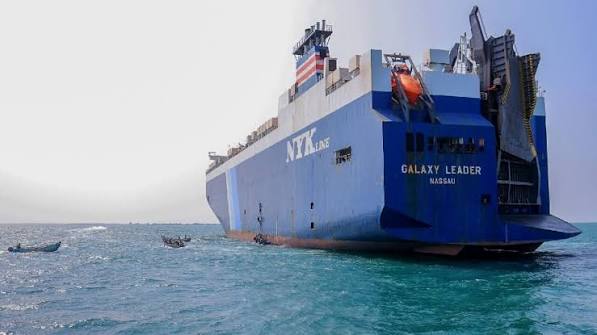
A cargo vessel came under fire in the Red Sea on Sunday, the latest maritime security incident off Yemen’s coast, even as a fragile U.S.-Iran ceasefire keeps oil flowing through the region’s other critical chokepoint.
The UK Maritime Trade Operations centre (UKMTO), a British agency that monitors shipping security threats, said it received a distress alert from a bulk carrier reporting it was “under attack by unknown armed assailants” approximately 30 nautical miles southwest of Hodeidah, a Yemeni port city controlled by the Iranian-backed Houthi movement. According to the UKMTO, a small skiff approached the vessel and opened fire; the ship’s security team returned fire before the attacking craft retreated to a larger vessel operating nearby with its transponder switched off. The cargo ship and its crew were reported safe, and the agency said authorities are investigating. No group had claimed responsibility for the attack as of Sunday afternoon.
“Vessels are advised to transit with caution and report any suspicious activity to UKMTO,” the agency said in a statement.
The incident came in the same 48-hour window as some of the most violent fighting seen in years between Houthi forces and government-aligned troops near Hodeidah, in which the rebels reportedly killed 16 government soldiers. A separate suspected piracy incident was also reported July 1 farther south, near Balhaf, when armed men aboard a small craft caused minor damage to a vessel’s bridge.
The Houthis, who control large portions of Yemen’s Red Sea coastline, began targeting commercial shipping in late 2023, disrupting one of the world’s busiest trade corridors and forcing many shippers to reroute around Africa. The group paused its campaign earlier this year, and a Houthi spokesperson did not immediately respond to requests for comment on Sunday’s attack.
The renewed uncertainty in the Red Sea comes as global energy markets are still adjusting to the aftermath of the four-month war between the United States, Israel and Iran, which effectively closed the Strait of Hormuz to much of its normal traffic between February and mid-June. The U.S. and Iran signed a memorandum of understanding on June 17 to end the conflict and reopen Hormuz, launching a 60-day negotiating window toward a permanent settlement.
In the interim, Saudi Arabia has leaned heavily on the Bab el-Mandeb Strait — the passage connecting the Red Sea to the Gulf of Aden, near where Sunday’s attack occurred — to keep oil moving to Asian markets. According to trade intelligence firm Kpler, the kingdom shipped roughly 34 million barrels of oil through Hormuz since mid-June, more than double the volume moved in the preceding three months, while simultaneously surging flows through its East-West Pipeline into the Red Sea corridor. That rerouting has helped offset lost Hormuz capacity for economies including Japan and South Korea, and benchmark Brent crude prices have fallen 39% from their March highs.
Any sustained disruption to Bab el-Mandeb traffic would complicate that arrangement, reintroducing risk to a route that has functioned as a relief valve for global oil supply during the Hormuz shutdown. Shipping insurers and vessel operators have watched the corridor closely since the Houthi campaign began in 2023, a period in which many container lines rerouted Asia-Europe voyages around the Cape of Good Hope, adding significant time and cost to global trade flows.
It remains unclear whether Sunday’s attack was carried out by Houthi forces, an unaffiliated criminal or piracy network, or another actor entirely — a distinction with real consequences for how shippers and insurers assess risk in the coming weeks. UKMTO and other Western maritime authorities continue to urge vessels transiting the area to maintain heightened vigilance and report unusual activity in real time.
— Jose E. Navarro, The Navarro Report / Human-Directed AI Journalism: Research, analysis, and editorial direction by the author. Drafted in partnership with Claude AI (Anthropic).