
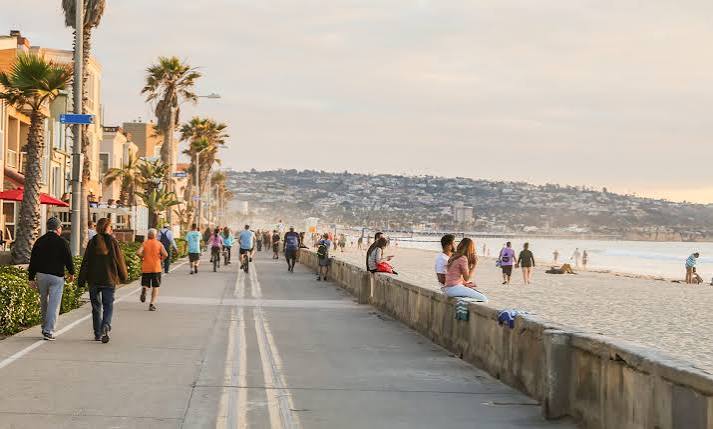
Third Serious Crash in Months Reignites Push for Pacific Beach Street Safety
By Jose E. Navarro | The Navarro Report | San Diego | July 9, 2026
A woman was struck by a car in a Pacific Beach crosswalk near 1200 Garnet Avenue late on July 2, the latest in a string of pedestrian and cyclist collisions that has turned a few blocks of the neighborhood into a flashpoint for San Diego’s broader debate over street safety. San Diego police said the woman was walking northbound in the crosswalk around 10 p.m. when a westbound driver failed to yield. The driver remained at the scene and was found at fault; the woman was hospitalized for abrasions and has since been released. A bystander who witnessed the crash near Tavern at the Beach described the immediate aftermath as chaotic, recalling that onlookers feared the worst before the woman began moving.
The July 2 crash lands on a corridor already marked by tragedy. In early February, 41-year-old Qwente Bryant, a manager at the same Tavern at the Beach, was killed in a hit-and-run just blocks away while walking home from work; police are still searching for a white SUV, possibly a Mercedes, with front-end damage. Weeks before that, on January 17, six-year-old Hudson O’Laughlin was killed while riding his bike with family on Pacific Beach Drive, when a driver turning into an alley struck him and then fled the scene. The child’s family has since filed a legal tort claim against the city, arguing that an unmarked alley crossing, obstructed sightlines from illegally parked cars, and the absence of red curb markings or warning signage combined to make the location a foreseeable hazard the city failed to correct.
A third fatal crash followed in March, when a 33-year-old bicyclist died after riding through a red light at Fanuel Street and Grand Avenue and colliding with a car. Advocacy groups have pointed to the pattern as evidence of a structural problem rather than a run of bad luck. Jessica Sportelli, president of the nonprofit BeautifulPB, said residents cannot on their own install better crosswalks, adjust speed limits, or enforce traffic laws — authority that rests solely with city leaders, she said, who need to act. Laura Keenan, who co-founded Families for Safe Streets San Diego after her husband was killed by a wrong-way driver in a protected bike lane, argues that the tools to prevent these collisions already exist; what has been missing, she said, is the political will to deploy them.
City officials say a response is already underway. San Diego City Council President Joe La Cava, whose district includes Pacific Beach, said his office is working with the mayor on a comprehensive speed management plan for the neighborhood, including reduced limits on both Pacific Beach Drive and Garnet Avenue. That plan is part of a larger, citywide Comprehensive Speed Management effort the council’s infrastructure committee has already begun advancing, which identifies roughly 679 centerline miles — about a fifth of San Diego’s entire road network — as eligible for speed reductions of up to five miles per hour under recent state legislation. The criteria prioritize corridors with histories of serious crashes, high pedestrian and bicycle activity, business districts, and school zones.
In the meantime, residents are taking the more immediate route available to them. A woman who witnessed the July 2 crash has begun collecting signatures on a petition and is urging neighbors to log complaints through the city’s Get It Done app, hoping a visible paper trail of resident concern will accelerate traffic-calming improvements before the next serious incident. City crews have already painted red curbs near the alley where Hudson O’Laughlin was killed, a reactive fix that residents say illustrates the pattern: infrastructure changes tend to arrive only after someone has already been hurt.
The tension La Cava has acknowledged publicly — that street safety depends on both engineering and human behavior — does not resolve the underlying question facing Pacific Beach: whether the city’s speed management plan, still under council review, will move fast enough to get ahead of a corridor that has now produced three serious pedestrian and cyclist incidents in a single year. For a neighborhood built around bars, restaurants, and beachfront foot traffic, the answer will shape how safely residents and visitors alike can walk to dinner or ride a bike home at night.
— Jose E. Navarro, The Navarro Report / Human-Directed AI Journalism: Research, analysis, and editorial direction by the author. Drafted in partnership with Claude AI (Anthropic).