
World Affairs — July 12, 2026
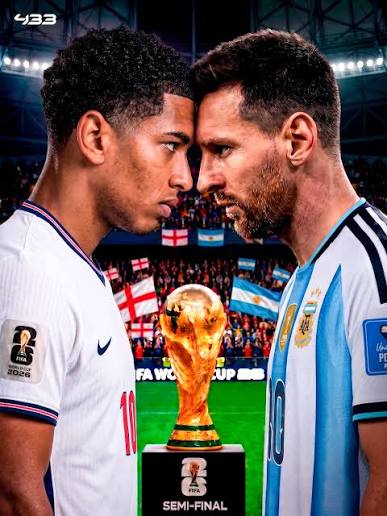
Lionel Messi has played 205 matches for Argentina and never once lined up against England. That changes Wednesday in Atlanta, where the two teams meet in a World Cup semifinal that both sides needed extra time just to reach.
England ground past Norway 2-1, saved again by Jude Bellingham, who scored twice to push his tournament tally to six goals and claim his fourth man-of-the-match award of the summer. Argentina needed the same extra half hour to get past Switzerland, winning 3-1 on second-half-of-extra-time goals from Julián Álvarez and Lautaro Martínez. Messi did not score in that game, snapping a streak that had produced a goal in every match he played dating back to the 2022 tournament in Qatar. He still leads the Golden Boot race with eight goals, tied with France’s Kylian Mbappé.
What makes Wednesday different is the history neither team can talk around. Argentina and England have met three times at World Cups, and each meeting produced a moment that outlived the scoreline: Diego Maradona’s Hand of God and his slalom run through five defenders in 1986, David Beckham’s redemption penalty in 2002 after his 1998 red card ended his tournament. The teams have not played each other anywhere, friendly or competitive, since 2005.
Messi, at 39 and playing what is likely his final World Cup, has been careful not to lean into the mythology. Speaking to ESPN, he said everything he knows about the 1986 match comes secondhand “from videos and images that Argentinians constantly watch and relive.” He called England “a powerhouse” and admitted the personal novelty of the fixture: “I’ve played against everyone except England, so it will be nice for that reason too.”
BBC pundit Micah Richards framed the tactical problem England now faces bluntly, saying marking Messi is “impossible because he doesn’t run back.” Former England captain Wayne Rooney offered the counterpoint, arguing that Messi’s lack of defensive work rate is real and exploitable, but that stopping him still comes down to disciplined communication rather than any single matchup.
There’s a version of this story that’s just about soccer, and it’s a great one on its own. But for readers on this side of the border, the semifinal lands differently. San Diego’s Tijuana-adjacent identity means this tournament has never been background noise here; it’s been dinner-table conversation since the group stage, and a Messi-Bellingham collision is the kind of match that empties bars early and fills them back up by kickoff. Juventus fans in the binational community have their own rooting interest tied up in how far Chiesa’s France and Spain go on the other side of the bracket, since the winner of Tuesday’s other semifinal awaits whoever survives Atlanta.
Argentina manager Lionel Scaloni was measured after the Switzerland win, calling England “a very tough opponent” and stopping short of any prediction. That restraint tracks with how this Argentina side has played the whole tournament: efficient, occasionally unconvincing in the group stage, but never rattled once the knockout rounds started.
Kickoff is set for Wednesday in Atlanta. The winner advances to face France or Spain in the final, meaning both semifinalists already know exactly what’s waiting for them. For a 39-year-old chasing the one line still missing from his résumé, and for an England side that keeps finding its best moments late, that’s about as clean a stage as the World Cup ever sets.
There’s a footnote to this quarterfinal round that says something about how the expanded tournament has gone for host cities. This is the first World Cup with 48 teams, and the bigger format has meant more knockout soccer landing in North American markets that don’t always get a semifinal-caliber matchup on their doorstep. Miami hosted Saturday’s England-Norway quarterfinal; Atlanta gets Messi’s first shot at England outright. San Diego didn’t land a marquee knockout match this cycle, but the region’s fingerprints are still on the tournament through the binational logistics that have quietly kept players, staff, and fans moving across the Tijuana border all summer.
The other half of the bracket is just as loaded. France and Spain play their own semifinal Tuesday, a rematch of sorts for a rivalry that has produced some of the tournament’s sharpest soccer, and the winner will already know it’s facing either the emotional weight of a Messi swan song or an England side riding Bellingham’s late-game heroics into a final. Whatever happens Wednesday, the sport doesn’t get many nights like this one.
— Jose E. Navarro, The Navarro Report / Human-Directed AI Journalism: Research, analysis, and editorial direction by the author. Drafted in partnership with Claude AI (Anthropic).