
By Jose E. Navarro, The Navarro Report
SAN DIEGO — Five months before the midterms, the rules for how Americans vote are being rewritten on two tracks at once — one in the U.S. Supreme Court, the other in statehouses racing to get ahead of it.
Five Democratic-led states have enacted new laws this year aimed at shielding November’s elections from potential federal interference, according to CNN, restricting the presence of law enforcement at polling places and pushing back against efforts by the Trump administration to obtain sensitive election data. The laws are a direct response to the president’s repeated claims of voter fraud and, more specifically, to his refusal last month to rule out sending ICE officers or National Guard troops to polling places. Asked directly, Trump said he would do “anything necessary to make sure we have honest elections.”
In Connecticut, a provision taking effect July 1 will bar law enforcement from coming within 250 feet of a polling location, ballot drop box, or vote-counting site without permission from election officials, according to state Rep. Matt Blumenthal, the Democrat who chairs his chamber’s elections committee and led the bill. Legal experts told CNN that states are likely on firmer constitutional footing when their laws regulate their own election officials rather than attempt to directly restrict federal action — a distinction that will matter if any of these laws face a court challenge.
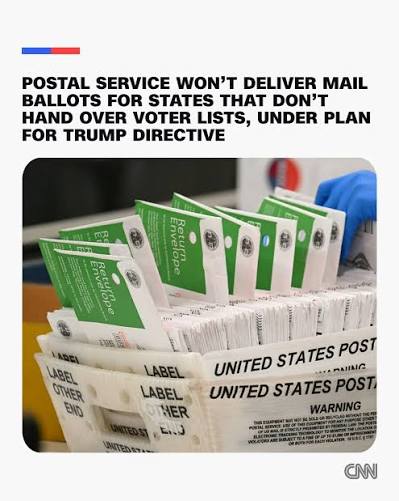
Maryland’s fight is narrower and more immediate: mail ballots. Democratic lawmakers there have objected to the administration’s efforts to curb mail-in voting, and the state’s 10-day grace period for ballots postmarked by Election Day is now entangled in a case the U.S. Supreme Court is actively deciding.
The case to watch: Watson v. RNC. At issue is a Mississippi law allowing mail ballots to be counted if they are postmarked by Election Day but arrive up to five business days later — one of 14 states, plus the District of Columbia, with a similar grace period. California is among them: ballots postmarked by Election Day can be received up to seven days afterward. The Republican National Committee argues that federal statutes dating to the 1800s, which set a single uniform Election Day for choosing the president and Congress, require ballots to be received by that date, not just mailed by it. Mississippi and its allies counter that counting votes has historically extended well beyond Election Day and is not itself part of “the election.”
The Trump administration, while not a party to the case, filed a brief in support of the RNC. Solicitor General John Sauer wrote that “ensuring all ballot boxes close on the same day eliminates incentives and opportunities for fraudulent abuse.” Mississippi Attorney General Lynn Fitch, a Republican, rejected that framing in her own filing, telling the court flatly: “Counting votes is not part of the election.”
During oral arguments in March, several of the court’s conservative justices — including Samuel Alito and Clarence Thomas — appeared skeptical of the state grace periods, while Chief Justice John Roberts and Justice Amy Coney Barrett pressed both sides on how a ruling against Mississippi might ripple into early voting rules more broadly. A decision is expected by late June or early July, according to Democracy Docket, putting the ruling on a collision course with primary season.
Local election officials are not waiting calmly. At an April meeting between the U.S. Election Assistance Commission and local election leaders in Chicago, Onondaga County, New York, election commissioner Dustin Czarny called a possible reversal “akin to a natural disaster.” “These types of situations take time and procedures to prevent humans from making mistakes — because humans make mistakes — and there will be no time between June and November,” he said. Mark Earley, the elections supervisor in Leon County, Florida, where the ruling would have no effect, said he sympathized anyway: “Big changes to election law are best deployed with advanced notice so we can get the education out to voters and let them know.”
The numbers at stake are not trivial. Roughly 103,000 mail ballots were rejected nationally in 2024 for arriving late, according to the U.S. Election Assistance Commission — about 18% of all mail ballot rejections that year. The Bipartisan Policy Center notes that states with and without grace periods reject ballots for lateness at similar overall rates, suggesting most voters adapt to whatever deadline is in place — but adaptation takes time most election offices won’t have if the ruling lands close to November.
Why it matters: Whatever the Supreme Court decides in Watson v. RNC will land in the middle of an already tense standoff between the White House and Democratic-led states over who controls the machinery of federal elections. For voters who rely on the mail — disproportionately rural voters, military families, and seniors — the next 90 days will determine whether the rules they’ve used for years still apply in November.
— Jose E. Navarro, The Navarro Report / Human-Directed AI Journalism: Research, analysis, and editorial direction by the author. Drafted in partnership with Claude AI (Anthropic).