
JERUSALEM — World Affairs | The Navarro Report
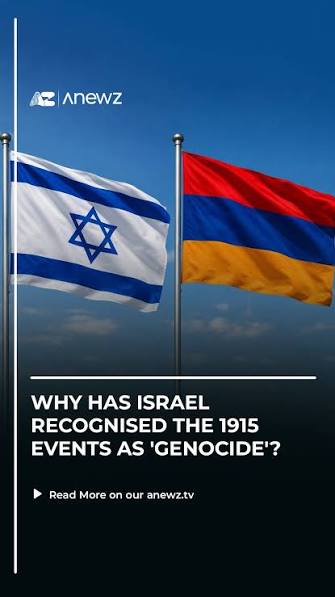
Israel’s Cabinet voted unanimously on June 28 to formally recognize the 1915 mass killings of Armenians under the Ottoman Empire as genocide, ending decades of official silence that Israeli governments maintained largely to protect the country’s strategic relationship with Turkey. The move drew an immediate, angry response from Ankara and a mixed reaction within Israel’s small Armenian community.
The resolution, brought before the cabinet by Foreign Minister Gideon Sa’ar, passed without a single dissenting vote. Sa’ar told the cabinet the decision was long overdue. “It is never too late to do the right thing,” he said, adding that the historical record surrounding the deaths of an estimated 1.5 million Armenians is not seriously disputed among historians. Prime Minister Benjamin Netanyahu, who had previously described the killings as genocide in personal remarks but had never brought the matter to a formal government vote, backed the measure. Asked days earlier whether he supported recognition, Netanyahu told reporters, “I certainly support it.”
Turkey’s foreign ministry rejected the move within hours, calling it politically motivated. Ankara accused Israel of using the designation to “cover up” its own conduct in the Gaza war, where Israel faces genocide allegations at the International Court of Justice. Israel denies those allegations, saying its military campaign has targeted combatants rather than civilians. The overlapping timing has drawn scrutiny from commentators on multiple sides of the debate: Israel is formally recognizing a century-old atrocity while simultaneously contesting a modern genocide accusation against itself, a juxtaposition that both supporters and critics of Sunday’s vote have raised.
The recognition still requires ratification by the full Knesset to become binding law. Sa’ar said he expects lawmakers to approve it, though no timeline has been set. With this vote, Israel joins roughly three dozen countries — including the United States, France, Germany and Russia — that formally recognize the Armenian genocide. Turkey, as the Ottoman Empire’s successor state, has never accepted the designation, arguing the deaths occurred amid the broader chaos and violence of World War I rather than as a coordinated campaign of extermination. Ankara has proposed a joint historians’ commission to examine the events, an offer Armenia has not taken up.
Reaction within Israel’s Armenian community, estimated at roughly 10,000 people concentrated largely in Jerusalem’s Old City, was described by community leaders as cautiously hopeful rather than celebratory. Cristina Movsesyan, chairwoman of the Union of Armenians in Israel, said her community’s feelings were “very divided,” welcoming the historic step while questioning why it arrived only after relations with Turkey had already collapsed. Community activists who have lobbied for recognition for decades described the vote as validation, even if the political circumstances surrounding it were imperfect.
Azerbaijan, one of Israel’s closest partners in the Muslim world on energy and defense cooperation, also objected, urging Jerusalem to reconsider and calling the designation a distortion of the historical record — a notable rebuke from a longtime ally. Armenia’s government welcomed the decision, though Armenian Prime Minister Nikol Pashinyan struck a measured tone, telling reporters his government saw no need to formally respond, a reflection of Yerevan’s own delicate balancing act with both Turkey and Azerbaijan as it pursues regional normalization.
The vote lands against the backdrop of an Israeli-Turkish relationship that has deteriorated sharply since the Gaza war began in October 2023. Turkish President Recep Tayyip Erdogan has emerged as one of the most vocal critics of Israel’s military campaign, while Netanyahu has in turn accused Erdogan of authoritarianism. Whether the genocide recognition further isolates the two governments, or simply formalizes a rupture that had already occurred, is likely to become clearer in the coming weeks as Turkey signals it plans to formalize its own diplomatic response.
For now, the episode illustrates how historical memory and present-day geopolitics remain difficult to separate in the Middle East, where governments continue to weigh moral claims against strategic interests — a dynamic that has shaped international debate over the Armenian genocide for more than a century, and one unlikely to resolve neatly for either Jerusalem or Ankara.
— Jose E. Navarro, The Navarro Report / Human-Directed AI Journalism: Research, analysis, and editorial direction by the author. Drafted in partnership with Claude AI (Anthropic).