

WASHINGTON — National Affairs | The Navarro Report
Three numbers tell most of the story of the American economy at the midpoint of 2026: 2.1 percent growth, a federal funds rate stuck at 3.5 to 3.75 percent, and 57,000, the number of jobs the economy added in June, badly missing forecasts. Underneath those headline figures sits a labor market that is cooling in a way that looks less like a normal cyclical slowdown and more like something structural, and a growing body of evidence pointing to artificial intelligence as one, though not the only, reason why.
Start with growth. Real GDP expanded at a 2.1 percent annualized rate in the first quarter of 2026, according to the Bureau of Economic Analysis’s third and final estimate, a rebound from the fourth quarter of 2025’s anemic 0.5 percent pace, which had been dragged down by a 43-day federal government shutdown that pulled 1.16 percentage points off output, the worst shutdown-related hit since 1994. But the path to that 2.1 percent figure tells its own cautionary tale: the government’s advance estimate in April put growth at 2.0 percent, the second estimate in May revised it down sharply to 1.6 percent, and the final June estimate revised it back up to 2.1 percent, a swing driven mostly by technical revisions to import and export data rather than any real change in the underlying economy. Consumer spending, which makes up roughly two-thirds of economic activity, was revised down to just 0.5 percent annualized growth in the final estimate, a much weaker number than the 1.6 percent originally reported. EY’s economics team summed up the pattern bluntly, writing that the economy’s foundation of growth has become narrower, with interest-rate-sensitive sectors struggling under elevated financing costs even as headline GDP holds up.
One place growth has not narrowed is business investment tied to artificial intelligence. Equipment spending surged 15.8 percent annualized in the first quarter, and spending on intellectual property products, which includes software and research and development, rose 13.8 percent, with analysts at EY explicitly attributing the concentration of business investment to AI-related activity. That investment boom is a genuine bright spot for GDP arithmetic. It is also, as the labor market section below explains, part of the same story behind the economy’s weakening job creation, since the money going into AI infrastructure and software is not, for the most part, going into new headcount.
The Federal Reserve, meanwhile, has pivoted unexpectedly hawkish just as the labor market has started to soften. Kevin Warsh, confirmed by the Senate as Fed chair on May 13 and succeeding Jerome Powell, held the benchmark federal funds rate steady at 3.5 to 3.75 percent at his first meeting on June 17, extending a hold that has now lasted since the Fed’s third consecutive quarter-point rate cut in December 2025. What surprised markets was not the hold itself but the committee’s tone: the Fed’s summary of economic projections showed nine of eighteen voting members projecting a rate hike before the end of 2026, with six projecting two separate quarter-point increases, and Warsh used his opening statement to declare the committee “unambiguous and unanimous” in its commitment to fighting inflation, invoking price stability twelve separate times in his press conference. He also broke with recent Fed practice by declining to submit his own rate projection to the dot plot, telling reporters flatly, “I did not submit a dot for me. It’s not helpful in the conduct of policy.” The shift sent the two-year Treasury yield up more than 16 basis points in a single day, the largest Fed-meeting-day move since March 2008.
The hawkish turn is driven mainly by inflation that has run above the Fed’s 2 percent target for more than five years and has recently gotten worse, not better, in large part because of an oil price spike tied to the Iran war, plus lingering effects from 2025 tariffs. Core PCE inflation, the Fed’s preferred gauge, was running at 3.3 percent over the twelve months through April, and the Fed’s own June projections see headline PCE inflation ending the year at 3.6 percent, up from a 2.7 percent projection back in March. That combination, inflation moving the wrong direction while job growth slows, is the textbook definition of the bind a central bank least wants to be in, since fighting one problem risks worsening the other. Not everyone on Wall Street buys the hawkish case: Citi Research’s Andrew Hollenhorst has argued in a series of notes that slowing payrolls and rising jobless claims point toward eventual rate cuts rather than hikes, calling much of Warsh’s early hawkishness “largely performative” positioning rather than a genuine signal of the Fed’s actual reaction function. The Fed’s next opportunity to clarify which view is right comes at its July 28 to 29 meeting, Warsh’s second as chair.
Weekly jobless claims, a more real-time gauge of labor market stress than the monthly payroll report, have been drifting higher over the course of 2026 without yet flashing a clear warning sign. Initial claims came in at 215,000 for the week ending June 27, down slightly from 226,000 two weeks earlier and from 228,000 in early June, levels that remain historically low but that have been trending upward compared with earlier in the year. Citi’s Hollenhorst has flagged the claims trend specifically as one reason he expects the labor market’s cyclical position, not just its structural one, to weaken further heading into the second half of the year.
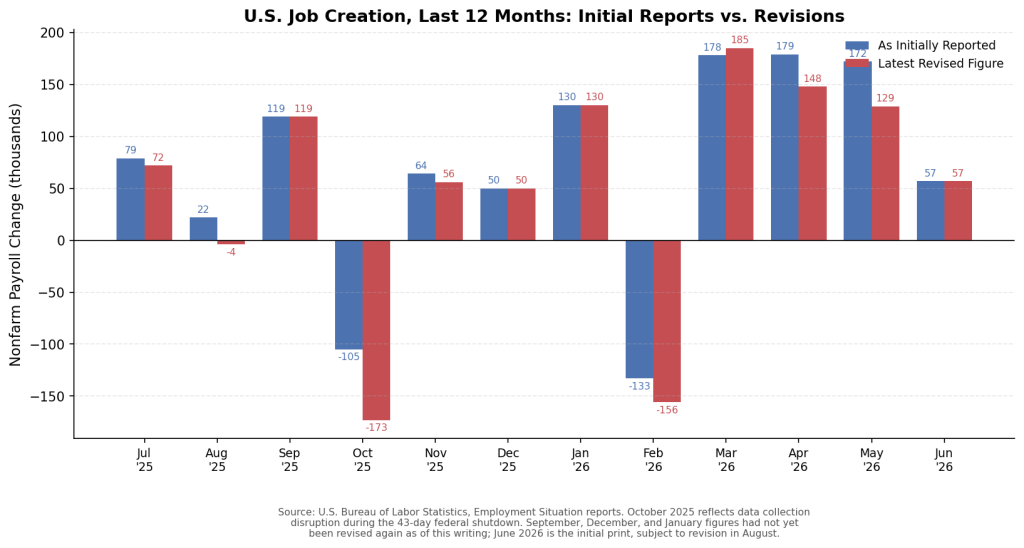
U.S. nonfarm payroll growth by month, July 2025–June 2026, initial vs. most recent revised figures. Source: BLS Employment Situation reports.
That brings the picture to the payroll data itself, and the pattern of revisions that has become one of the most consistent, and most politically fraught, features of the last twelve months of jobs reports. The chart above shows nonfarm payroll growth for every month from July 2025 through June 2026, comparing the figure as initially reported against the most recent revised figure the Bureau of Labor Statistics has published for that month. Two things stand out. First, revisions have run overwhelmingly in one direction: downward. July 2025’s initial +79,000 print was revised to +72,000; August’s initial +22,000 became an outright loss of 4,000 jobs; October, disrupted by the federal shutdown that also delayed and complicated data collection that month, went from an already-weak initial estimate of -105,000 to a considerably worse -173,000; February 2026 fell from -133,000 to -156,000; and most recently, April and May 2026 were both revised down by a combined 74,000 jobs in the same June report that delivered the disappointing 57,000 headline figure for June itself. Only a handful of months, September, December and March among them, have so far avoided a downward revision, and March was actually revised up modestly, from +178,000 to +185,000.
Second, the size of the swings has been unusually large by historical standards. A financial commentary from Moneywise described the April-May revision specifically as “a classic late-cycle tell,” the pattern where initial estimates flatter the economy and a truer, weaker number shows up a month or two later once more complete survey responses come in. The Bureau of Labor Statistics has also had to contend with genuine data collection disruptions this cycle: the October 2025 shutdown forced the agency to cancel that month’s report outright and later fold estimated October activity into the November release, while a separate annual benchmark revision, not yet finalized for 2026 but flagged for preliminary release in August, could add or subtract hundreds of thousands of jobs from the government’s running total once QCEW tax-record data is fully incorporated, the same kind of revision that cut March 2025’s total nonfarm employment by 911,000 jobs, or 0.6 percent, when it was finalized earlier this year.
Which brings the story to artificial intelligence, and to a genuinely unresolved argument among economists about how much of the current hiring slowdown AI is actually causing versus merely providing convenient cover for. The most aggressive predictions belong to AI executives themselves: Anthropic CEO Dario Amodei has forecast that AI could eliminate half of all entry-level white-collar jobs within five years and push unemployment into double digits, while Microsoft’s AI chief Mustafa Suleyman has predicted office jobs will “crumble” within eighteen months, and Verizon CEO Dan Schulman has said AI could push unemployment up by as much as 30 percent over the next two to five years. Former Fed Chair Jerome Powell himself warned before leaving office that AI is quietly affecting the labor market as job creation hovers near zero, an observation that lines up uncomfortably well with June’s 57,000 print and a twelve-month average monthly gain of just 36,000, a fraction of the pace seen in most of the post-pandemic recovery.
The harder data is more measured than the headline predictions but points the same direction. A National Bureau of Economic Research working paper surveying 750 chief financial officers found 44 percent planned some AI-related job cuts this year, which the study’s authors calculated would amount to roughly 502,000 jobs economy-wide, about 0.4 percent of the workforce, but a nine-fold increase over the 55,000 AI-attributed layoffs tracked by Challenger, Gray & Christmas in all of 2025. Technology firms have been hit hardest and earliest: more than 85,000 tech-sector jobs were eliminated through April 2026 alone, a 33 percent increase over the same period the year before, with companies including Amazon, Meta and Intuit explicitly citing AI-driven restructuring in layoff announcements. Goldman Sachs has separately estimated that AI is already reducing US employment by roughly 16,000 jobs a month economy-wide, a relatively modest drag on its own but one that compounds month after month.
Where the evidence is clearest is at the entry level. The unemployment rate for recent college graduates has climbed to 5.6 percent, well above the 35-year average of 4.5 percent, according to Federal Reserve Bank of New York data, and Yale Insights researchers have described the phenomenon as job destruction that hits “before careers can start” rather than displacing established workers outright. Boston Consulting Group research found that software engineering headcount across the technology sector has continued growing since the release of ChatGPT, but at a much slower annual pace of about 2 percent, leading the study’s authors to conclude that AI is, so far, helping engineers work more effectively rather than replacing them wholesale, a more optimistic read that starting salaries for computer science graduates, projected to rise nearly 7 percent this year according to the National Association of Colleges and Employers, seem to partially support. That divide, older and more experienced workers largely insulated so far, younger workers and new graduates absorbing most of the disruption, is echoed in a recent International AI Safety Report, which found that employment in AI-exposed occupations has declined specifically for younger US workers even as it has held steady or risen for older ones since ChatGPT’s public release.
None of this means AI fully explains June’s weak jobs report, or the run of downward revisions that preceded it. Elevated interest rates, oil-driven inflation from the Iran war, and lingering tariff effects are all doing real, measurable damage to hiring in their own right, and most labor economists are reluctant to assign a single cause to a slowdown with this many moving parts. But the entry-level unemployment data, the concentration of layoffs in AI-exposed white-collar roles, and the simple fact that business investment is surging in AI infrastructure at the same time headcount growth is stalling, add up to a case that is difficult to dismiss as coincidence. If Fed Chair Warsh is right that current inflation leaves little room for rate cuts this year, and if AI-driven restructuring continues to weigh most heavily on the entry-level jobs young workers rely on to start their careers, the second half of 2026 may test how well America’s economic playbook, built around a central bank managing a business cycle, works against a labor market being reshaped by something closer to a permanent technological shift.
— Jose E. Navarro, The Navarro Report / Human-Directed AI Journalism: Research, analysis, and editorial direction by the author. Drafted in partnership with Claude AI (Anthropic).