SAN DIEGO, California — June 25, 2026
The case that ended at the U.S. Supreme Court today started here.
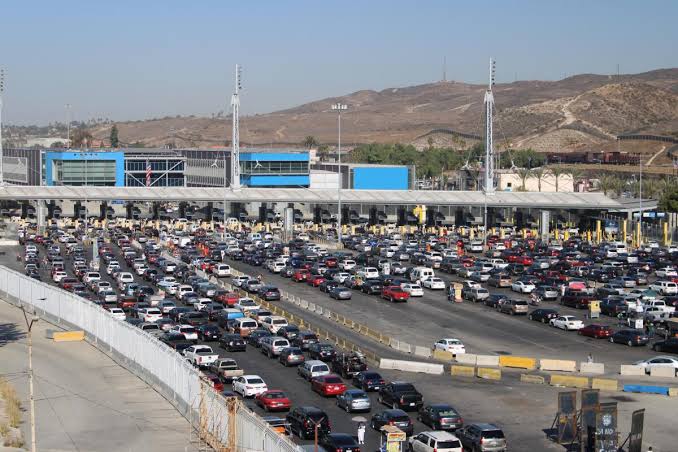
In 2017, immigrant rights organization Al Otro Lado — founded and based in San Diego — filed a federal class action lawsuit in the Southern District of California challenging the government’s practice of physically blocking asylum seekers from approaching ports of entry on the U.S.-Mexico border. The policy was called “metering.” The port it targeted most prominently was San Ysidro.
Today, the Supreme Court ruled 6-3 that the policy is constitutional. Writing for the six conservative justices, Justice Samuel Alito declared: “An alien standing in Mexico does not ‘arriv[e] in the United States’ by attempting, and failing, to set foot in this country. The INA neither entitles such an alien to apply for asylum nor requires an immigration officer to inspect him.”
Metering was initially deployed by the Obama administration specifically to manage a surge of Haitian immigrants who predominantly traveled to the San Ysidro Port of Entry in San Diego to seek asylum. The first Trump administration formalized and expanded the policy in a 2018 memorandum. The Biden administration rescinded it in 2021, shortly after the Southern District court ruled against it. Today’s ruling reverses that lower court decision — and authorizes the current administration to reinstate the practice at any time.
The consequences of that authorization are immediate and direct for San Ysidro, which handles more than 70,000 northbound crossings daily and is the busiest land port of entry in the Western Hemisphere. Under the ruling, CBP officers can now legally position themselves on the U.S. side of the border line and turn asylum seekers away before they physically cross — without any legal obligation to screen, inspect, or process their asylum claims.
Justice Sonia Sotomayor, dissenting alongside Justices Elena Kagan and Ketanji Brown Jackson, was pointed in her critique: the metering policy “had little to do with capacity issues,” she wrote, citing a CBP whistleblower report alleging that officers were “instructed to lie to people” by telling them the port was at capacity when it was not. Sotomayor blamed metering for creating the “dire humanitarian conditions at the border” in which migrants were left encamped on the Mexican side of the line, vulnerable to exploitation, violence, and cartel recruitment.
Justice Ketanji Brown Jackson added a separate five-page dissent arguing the court never should have taken the case at all, given that metering was rescinded years ago and the Trump administration has “no concrete plans to reinstate” it — chiding the majority for a “rush to greenlight this retired practice.”
But the majority’s ruling is not academic. The ruling clears the legal path for reinstatement — and with it, the humanitarian and civic consequences San Diego communities know from direct experience. Between 2016 and 2021, metering produced thousands of asylum seekers stranded in Tijuana’s border zone, concentrated in makeshift encampments from Colonia Independencia to El Chaparral plaza. Many waited months for an appointment number that would let them approach the port. Many were preyed upon while waiting.
For City Heights, Barrio Logan, Logan Heights, and National City — neighborhoods that have absorbed wave after wave of asylum-seeking families — the ruling is not a legal abstraction. It determines whether a neighbor’s mother, a child’s uncle, a congregation member’s cousin can reach the door and ask. Today’s Supreme Court said the door can be legally closed — before anyone gets close enough to knock.
— Jose E. Navarro, The Navarro Report / Human-Directed AI Journalism: Research, analysis, and editorial direction by the author. Drafted in partnership with Claude AI (Anthropic).