
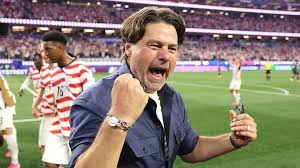
LOS ANGELES / INGLEWOOD, Calif. — June 27, 2026
There is a town in the Santa Fe province of Argentina called Murphy. It has no stadium, no professional club, and a population that would fit inside a modest American high school gymnasium. It is not a place that typically produces men who go on to coach at the FIFA World Cup. And yet, on a warm June evening at Los Angeles Stadium, as 90,000 people roared and the United States Men’s National Team dismantled Paraguay 4-1 in the most commanding opening performance in program history, the man responsible for all of it stood on the touchline in a crisp suit, arms folded, composed in the way only someone who has navigated the chaos of the biggest stages in world soccer can be.
Mauricio Pochettino had arrived.
The Argentine’s appointment as USMNT head coach in August 2024 was simultaneously the most ambitious and the most unusual hire in the program’s modern history. Here was a man who had played for Argentina — 20 international caps, appearances in all three of his country’s matches at the 2002 World Cup under Marcelo Bielsa — now entrusted with leading the nation whose fans still occasionally confuse soccer with the other football. The symmetry was almost too clean: an Argentine coming to redeem a host nation that hadn’t reached a World Cup semifinal since 1930.
But for anyone paying attention to Pochettino’s career, the appointment made complete sense.
**From the Pampas to the Champions League Final**
Pochettino grew up the son of farmers Hector and Amalia in Murphy — cattle country, flat land, and an ethic of work that would define everything he became. He began his career at Newell’s Old Boys, the Rosario club that also produced Lionel Messi and Gabriel Batistuta, before earning a move to Espanyol in Spain at the start of the 1994-95 season. He became a disciplined and intelligent center-back, known not for flashy play but for positional clarity and tactical awareness. Two Copa del Rey titles as a player. A reliable professional.
When Bielsa called him into the Argentina national team, Pochettino absorbed something that would shape his entire managerial philosophy: the obsessive commitment to pressing, to collective organization, to making the game uncomfortable for the opponent at every turn. Playing in South Korea and Japan in 2002 alongside icons like Juan Sebastián Verón, Hernán Crespo, and Gabriel Batistuta — despite Argentina’s early group-stage exit — gave him a World Cup education from the inside.
He moved to Paris Saint-Germain as a player from 2001 to 2003, making 70 appearances and experiencing the peculiar pressure of a club where expectation is permanent and patience is scarce. He finished his playing career at Espanyol in 2004 before transitioning almost immediately into management, where his talent for building cohesive, high-intensity teams became evident almost at once.
Southampton came first — a relegation candidate transformed into a team that punched upward with remarkable consistency. Then Tottenham Hotspur, where Pochettino produced arguably the most compelling sustained project in Premier League history without winning a trophy: pressing, structured, relentless, built around the development of players rather than the accumulation of stars. He took Spurs to the 2019 UEFA Champions League Final — a result that still represents the club’s finest modern achievement — before being dismissed despite everything he had built.
Paris Saint-Germain came next, in a dressing room that contained Lionel Messi, Kylian Mbappé, and Neymar Jr. simultaneously. He won a Ligue 1 title there in 2022. The expectation of Champions League glory, however, proved elusive, and he was eventually replaced. Chelsea followed in 2023-24, a stabilization job on a squad in institutional chaos — he improved the club from 12th to 6th, reached the EFL Cup final, and was let go at season’s end as ownership reconsidered its direction.
Then came the call that surprised almost everyone except, it seems, Pochettino himself.
**Building Something From Scratch — In Less Than Two Years**
The mandate was clear and the timeline compressed: take the USMNT, which had reached the round of 16 at the 2022 World Cup under Gregg Berhalter, and build a team capable of making a meaningful run in front of a home crowd at the 2026 tournament. Two years. A young, talented but inconsistent pool of players. And the weight of a nation that was hosting the World Cup for the first time since 1994, when a different kind of American soccer dream was briefly alive.
Pochettino got to work with characteristic thoroughness. Between October 2024 and May 2026, he called in 61 different players, pulling from 16 different leagues across 12 countries, assembling a picture of exactly what he had to work with and who he could trust. Twenty-two different players contributed to the 42 goals scored under his tenure. The roster he announced on May 26 at a televised event in New York City — 26 players, broadcast live on FOX — reflected not sentiment but system.
“We are confident this is the best group of 26 players to help us achieve success at the World Cup,” Pochettino said at the announcement. “These were very difficult decisions, and we are thankful to all the players who were part of this journey.”
The difficult decisions were real. Diego Luna, a popular attacking midfielder who had thrived under Pochettino during the 2025 Gold Cup and earned genuine fan support, did not make the cut. Tanner Tessmann, one of the most technically composed Americans in Europe, was left home after a muscle strain at Lyon raised questions about his readiness. Rather than replace him with another central midfielder, Pochettino selected a tenth defender in Joe Scally — a signal that his tactical setup, built around a back three, required bodies he could trust over novelty he could not.
The headline names were there: Christian Pulisic (AC Milan), Weston McKennie (Juventus — and yes, a Juventus midfielder matters in this household), Tyler Adams (Bournemouth), and Folarin Balogun (Monaco), who had scored 19 goals across all competitions in the club season. Ricardo Pepi at PSV Eindhoven added another 19-goal striker to the mix. The forward depth was, by historical USMNT standards, extraordinary.
**Three Matches, Three Stories, One Statement**
Group D opened June 12 at Los Angeles Stadium. In front of 85,000 fans, the United States scored four goals against Paraguay — the most in a single World Cup match in program history. The performance validated Pochettino’s tactical approach immediately: high press, rapid transitions, composure in front of goal. Pulisic was a constant threat. Balogun converted. McKennie controlled.
“On behalf of the whole team, massive thank you to the fans because the energy that they translated to the team was amazing,” Pochettino said afterward. “We can do amazing things if the fans are in this as well.”
A week later in Seattle, the United States shut out Australia 2-0. An own goal in the 11th minute and a header from 21-year-old Alex Freeman in the 43rd — a player who had made his first professional start for Orlando City barely a year before this moment — sealed the group stage before it was even finished. Six points from two matches. The fastest the United States had ever clinched advancement under the World Cup’s current format. The first time the program had won its opening two World Cup matches since 1930.
The third match, against already-eliminated Türkiye on June 25 in Inglewood, was where Pochettino made his most audacious call: nine changes to the starting lineup. The most ever between two consecutive USMNT World Cup matches, and the third-most in a single match in World Cup history. The reserves competed hard. Sebastian Berhalter — son of former USMNT coach Gregg Berhalter, the man Pochettino replaced — scored and assisted in the same match, becoming the first American to accomplish that combination in the modern era of the tournament. A 98th-minute Turkish goal made the final score 3-2, but the group standing was already determined.
“The objective was to finish first, and we are first,” Pochettino said. “Now, it’s the next stage. It’s going to be a final, and we are ready. We are much better than before that game because we have players now with 90 minutes in their legs, performing and ready to help if we need. It’s all positive. I am so positive, and I am happy.”
Twenty-one different starters used across the group stage — more than any other nation in the tournament. A program-best six points. Eight goals scored in a single World Cup, also a program record. Group D champions, advancing to the Round of 32 where they will face Bosnia and Herzegovina on July 1 at Levi’s Stadium in Santa Clara.
**The Question That Remains**
Pochettino has never won a major trophy as a manager. Tottenham, PSG, Chelsea — brilliant work, incomplete results. The narrative has followed him like a shadow. But this World Cup, on home soil, with a young and fearless squad that has now set program records in its first three matches, offers something none of those chapters could: a clean slate, a live tournament, and a nation that is genuinely watching.
The man from Murphy came to the United States with a philosophy, a willingness to take risks, and the quiet confidence of someone who has coached Messi and Mbappé and Kane and still believes the best is ahead. Group D was not the destination. It was the proof of concept.
The tournament is just beginning.
— Jose E. Navarro, The Navarro Report / Human-Directed AI Journalism: Research, analysis, and editorial direction by the author. Drafted in partnership with Claude AI (Anthropic).