
By Jose E. Navarro | The Navarro Report | June 28, 2026
For the second consecutive day, Iran and the United States traded military blows across the Middle East — and by Sunday evening, the fragile peace framework both countries signed less than two weeks ago appeared to be disintegrating in real time.
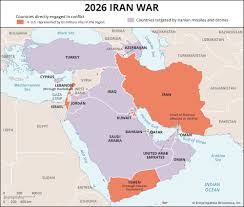
Iran’s Islamic Revolutionary Guard Corps launched a coordinated missile and drone operation in the predawn hours of Sunday, June 28, targeting U.S. military infrastructure in two Gulf states. The IRGC claimed it struck eight targets at the Ali Al Salem air base in Kuwait and at Port Salman in Bahrain, home to the U.S. Navy’s 5th Fleet. In a statement that left little room for diplomatic interpretation, the Guard said its forces had “decisively responded to recent U.S. aggression” and warned that any future American strikes would be met with “a crushing response.”
Kuwait’s air defenses intercepted two Iranian ballistic missiles. There were no reported casualties or significant damage. Bahrain was less fortunate: the country’s Interior Ministry confirmed that Iranian munitions destroyed the top floor of an eight-story residential building near the international airport, releasing photos of the gutted structure with windows blown out and rubble cascading through the upper floors. Miraculously, no one was killed. Air raid sirens sounded twice over Bahrain before dawn.
Kuwait condemned what it called “the repeated, heinous Iranian aggressions” and described the strikes as “a flagrant violation” of its sovereignty and a breach of the United Nations Charter. Bahrain’s Foreign Ministry went further, calling the attacks “a dangerous escalation that reveals that what Tehran is doing is not a passing act, nor an isolated incident, but rather a deliberate approach and a systematic pattern of repeated aggression.” The UAE, Qatar, and Egypt issued parallel condemnations, and Bahrain urged the U.N. Security Council to convene an emergency session.
The backdrop makes every exchange more consequential. On June 18, the United States and Iran signed a 14-point memorandum of understanding pausing hostilities and beginning a 60-day negotiating window to resolve the core disputes from their February war — Iran’s nuclear program, the removal of a U.S. naval blockade, and critically, control of the Strait of Hormuz. The strait carries approximately 20 percent of the world’s oil and liquefied natural gas, and it has become the sharpest fault line in the talks.
Iran insists it alone governs the waterway. The U.S. position — backed by international maritime law and every Gulf state — is that the strait is an international passage open to all. When a multinational maritime body overseen by the U.S. Navy announced Saturday it would expand an alternate shipping route near Oman’s coast, bypassing Iranian-controlled waters, Tehran treated it as a declaration of war. Iranian drones attacked the Panama-flagged tanker M/T Kiku — carrying crude oil for Qatar’s state-run energy company — as it attempted to use the new route. U.S. Central Command retaliated with strikes on 10 Iranian military targets.
Iran’s response to Sunday’s escalation came not just in missiles but in words. Foreign Minister Abbas Araghchi, speaking in Baghdad during diplomatic consultations with Iraqi officials, delivered a pointed warning to the region: “Any attempt to establish new or separate arrangements from those currently being carried out by the Islamic Republic of Iran will only lead to more complicated situations and delays in the reopening of the Strait of Hormuz, and will increase the tensions.” He urged all parties to “adhere to the memorandum of understanding and not to allow this MoU to deviate from its course” — while simultaneously suggesting that Iran’s own strikes were a justified response to American violations of that same agreement.
The IRGC’s statement went further, threatening “the complete halt of all diplomatic processes” if U.S. strikes continued. Iran’s parliament speaker, Mohammad Bagher Qalibaf, called for an emergency meeting of a new “conflict control unit” involving Iran, the U.S., and Lebanon.
President Trump, for his part, doubled down on Saturday’s Truth Social warning that the U.S. could be forced to “militarily complete the job that we very successfully started” — adding that if it came to that, “the Islamic Republic of Iran will no longer exist.” A U.S. official confirmed Sunday that all Iranian drones and missiles were shot down, intercepted, or failed to reach their targets, with no American injuries or damage to U.S. locations.
Pakistan, serving as a key mediator, said talks between Washington and Tehran would resume Tuesday. Whether both parties actually show up may be the most telling indicator yet of whether this ceasefire survives. A Qatari coast guard vessel was also caught in the crossfire Sunday — one Qatari citizen was killed by shrapnel, a grim reminder that even neutral mediators are not safe in the corridors of this war. The toll of miscalculation keeps climbing.
— Jose E. Navarro, The Navarro Report / Human-Directed AI Journalism: Research, analysis, and editorial direction by the author. Drafted in partnership with Claude AI (Anthropic).