
WASHINGTON — July 6, 2026
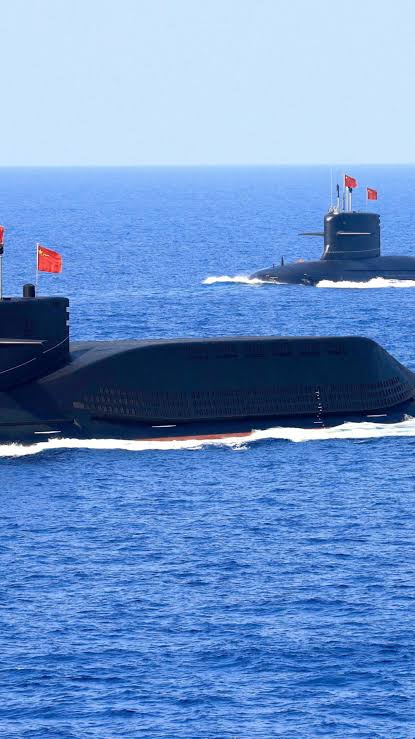
China announced Monday that it had launched a long-range ballistic missile from a nuclear-powered submarine into the Pacific Ocean, a rare public disclosure of the country’s sea-based nuclear capability that landed a day before NATO leaders were set to gather in Ankara, Turkey, for their annual summit.
Chinese state media reported that the People’s Liberation Army Navy fired the missile, carrying a dummy warhead, from a Type 094-class Jin-class submarine at midday local time as part of what Beijing described as a routine annual training exercise. Foreign ministry spokesperson Mao Ning told reporters the launch was “consistent with international law and customary international practice” and was “not directed at any specific country or target,” adding that Beijing hoped other nations would not “read too much into it.” Analysts note it was the first known test of this kind since 1982 and China’s first long-range ballistic missile launch since a 2024 test near French Polynesia, which was itself Beijing’s first declared intercontinental test since 1980.
The test did not go unnoticed. NATO Secretary-General Mark Rutte, speaking at a pre-summit briefing in Ankara, said the alliance “cannot be naive” about China’s military buildup, arguing that developments in the Indo-Pacific and the trans-Atlantic region “are also relevant” to one another. Rutte said he had already been in contact with Japan’s defense minister about the launch. Australian Foreign Minister Penny Wong, speaking from Fiji hours after Canberra signed a new security pact with the island nation, said the test “undermines” regional stability. New Zealand’s foreign minister, Winston Peters, said Wellington and its Pacific neighbors have “no interest” in seeing the South Pacific used as a proving ground for Chinese missile capability, even though he acknowledged Beijing had provided advance notice of the exercise. Taiwan’s presidential office also condemned the launch, characterizing it as an attempt to pressure the international community amid years of rising Chinese military activity near the island.
Pentagon assessments cited by defense analysts describe China as simultaneously expanding all three legs of its nuclear triad — land-based missiles, strategic bombers, and submarine-launched weapons — while working to improve its ability to survive a first strike and respond in kind. The Pentagon’s most recent public estimate put China’s stockpile at roughly 600 nuclear warheads as of 2024, a figure it projects could approach 1,000 by 2030. The country also fields the world’s largest navy by number of hulls and has invested heavily in hypersonic weapons, long-range missile forces, and space and cyber capabilities that U.S. officials say are intended to offset traditional American military advantages in the region.
The timing has fueled speculation, though maritime intelligence analysts caution the launch was likely scheduled well in advance rather than choreographed around the NATO gathering. Mark Douglas, an analyst with the vessel-tracking firm Starboard Maritime Intelligence, told wire services that while the test was probably long-planned, its timing amid heightened Pacific diplomatic activity was notable regardless of intent.
The NATO summit in Ankara, which opens Tuesday, is expected to focus primarily on defense spending commitments, industrial capacity, and continued support for Ukraine, alongside a broader alliance effort — described by some officials as a “NATO 3.0” posture — to balance threats from both Russia and China simultaneously. Turkey’s growing strategic weight within the alliance, driven by its military capability and geographic position along NATO’s eastern and southern flanks, has become a notable subplot of the gathering. President Trump is expected to meet separately with Ukrainian President Volodymyr Zelensky on the sidelines this week.
The launch also landed against the backdrop of shifting Pacific alliances. Australia’s security pact with Fiji, signed only hours before China’s test, is itself part of a wider contest for influence among Pacific island nations, where Washington and Canberra have grown increasingly concerned about Beijing’s efforts to expand economic and security ties in the region. A Chinese foreign ministry spokesperson, asked Monday about the Australia-Fiji pact, said Beijing hoped “relevant countries” would respect the independence of Pacific island nations and avoid harming the interests of unspecified “third parties,” a comment widely read as a rebuke of the agreement.
For now, China’s test serves as a reminder to summit attendees that great-power competition is not confined to the European theater. Whether the launch prompts any concrete new alliance commitments toward the Indo-Pacific, or remains a rhetorical talking point layered onto an agenda already crowded with Ukraine and defense-spending disputes, is likely to become clearer as the two-day summit unfolds. What is already evident is that Washington’s allies on both sides of the globe are increasingly treating Beijing’s and Moscow’s military postures as connected challenges rather than separate regional concerns, a framing that is likely to shape how NATO approaches its own long-term planning well beyond this week’s meetings in Turkey.
— Jose E. Navarro, The Navarro Report / Human-Directed AI Journalism: Research, analysis, and editorial direction by the author. Drafted in partnership with Claude AI (Anthropic).