SEATTLE — July 6, 2026
The U.S. Men’s National Team’s bid for its first World Cup quarterfinal since 2002 ended in a 4-1 loss to Belgium on Monday night at Lumen Field, a defeat that unfolded only after a week of controversy over how star forward Folarin Balogun came to be on the field at all.
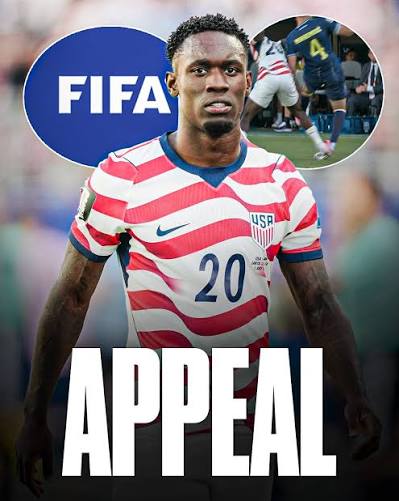
Balogun, the tournament co-hosts’ leading scorer with three goals, had been serving an automatic one-game suspension after picking up a red card in the Round of 32 win over Bosnia and Herzegovina on July 1. Television replays showed Balogun stepping on the ankle of Bosnian defender Tarik Muharemovic during a collision in the second half; the referee, backed by a VAR review, judged it a serious foul and sent him off, triggering a suspension that under FIFA’s disciplinary code is not normally subject to appeal.
That changed after President Donald Trump telephoned FIFA President Gianni Infantino last Wednesday to ask that the card be reconsidered. “I asked for a review because I didn’t think it was a foul,” Trump told reporters Monday, adding that he considered the collision the product of “two great athletes” who had become tangled up. By Sunday, FIFA’s disciplinary committee had suspended enforcement of Balogun’s ban for a one-year probationary period, clearing him to face Belgium a day later. Infantino confirmed the call had taken place but said FIFA’s judicial bodies remain independent and decide cases “based on their applicable regulations and the specific facts before them.”
The reversal, the first of its kind in more than six decades of World Cup competition, drew swift and pointed criticism from soccer’s governing bodies in Europe. UEFA called the decision “unprecedented, incomprehensible and unjustifiable” and said it had “crossed a red line,” arguing that an automatic one-game suspension is not meant to be discretionary. Former FIFA president Sepp Blatter weighed in as well, writing that red cards “are not overturned by political phone calls” and asking, pointedly, “Quo vadis, FIFA?”
The Royal Belgian Football Association pursued its own last-ditch challenge, saying it had merely sought an explanation from FIFA and was startled when the governing body treated its letter as a formal appeal, then rejected that appeal hours before kickoff on the grounds that Belgium’s federation was not a party to the original proceeding. In a statement, the RBFA said it was “astonished” by the sequence of events, noting that every other red card issued in this tournament had resulted in an automatic ban. FIFA’s Appeals Committee determined the Belgian federation lacked standing to contest the matter, and the decision stood.
Reaction inside the tournament was mixed. Belgium head coach Rudi Garcia told reporters his team would take the field “defending football with its ethics and integrity,” while goalkeeper Thibaut Courtois said the timing was a surprise but changed nothing about his team’s preparation. England manager Thomas Tuchel, whose own team is playing this bracket without a defender serving an unrelated red-card suspension, questioned aloud how far the precedent might extend. Former Manchester United and England forward Wayne Rooney was more blunt, calling the reversal “an absolute disgrace” in television commentary.
On the field, the controversy proved moot for the U.S. cause. Belgium controlled large stretches of the match and scored four times, including a second-half goal from midfielder Hans Vanaken, to eliminate the co-hosts from their own tournament. Balogun played the match but was unable to prevent the defeat, ending American hopes of reaching the quarterfinals for the first time since South Korea and Japan hosted the event in 2002.
The episode has become a flashpoint in a broader conversation about the role politics has played around this summer’s World Cup, the first edition to be jointly hosted by the United States, Mexico and Canada and the first to feature 48 teams. Supporters of the intervention have argued that a president taking interest in a co-host nation’s fortunes is unremarkable; critics counter that a direct call from a head of state to a sport’s governing body, followed within days by a reversal of a disciplinary ruling, raises legitimate questions about competitive fairness regardless of which country benefits. FIFA has not indicated it will revisit the episode, and the probationary status attached to Balogun’s suspension means any similar infraction during the following year would trigger the original ban.
With the U.S. eliminated, the World Cup continues without its co-host as the knockout rounds progress toward the quarterfinals later this week.
— Jose E. Navarro, The Navarro Report / Human-Directed AI Journalism: Research, analysis, and editorial direction by the author. Drafted in partnership with Claude AI (Anthropic).