
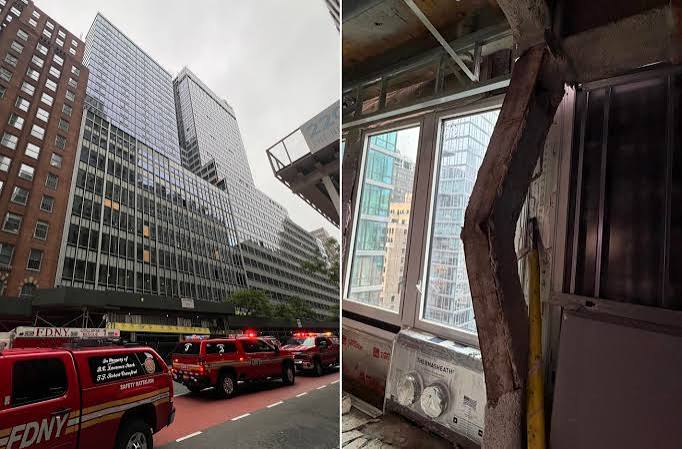
A Midtown Manhattan high-rise building identified by city officials as at risk of partial collapse remains structurally unstable and continues to shift, according to updated assessments released this week, even as emergency shoring efforts proceed around the clock.
City officials, joined by New York Mayor Zohran Mamdani, briefed the public on the ongoing stabilization work, describing a coordinated effort involving structural engineers, the Department of Buildings, and emergency response crews. Authorities have not fully detailed the cause of the instability, but the situation has prompted evacuations and street closures in the surrounding blocks as a precaution against further movement.
The episode has renewed scrutiny of aging infrastructure in one of the country’s densest urban cores, where high-rise buildings constructed decades ago sit alongside newer construction, often with limited public visibility into ongoing maintenance and structural inspection records. Building safety advocates have long argued that New York’s inspection regime, while more rigorous than in many cities, still relies heavily on self-reporting by building owners between mandated facade and structural reviews.
For residents and business owners near the affected block, the disruption has been immediate and tangible: closed sidewalks, rerouted foot traffic, and, for some, temporary displacement from homes or workplaces while engineers determine whether the building can be stabilized in place or must be further secured through demolition of at-risk sections.
City officials have sought to strike a balance between transparency and avoiding public alarm, emphasizing that the shoring efforts are proceeding as planned even as the building continues to move. That kind of qualified reassurance is familiar to anyone who has followed past infrastructure scares in major American cities, from bridge inspections to subway tunnel deterioration, where officials must communicate real risk without triggering panic before a full picture emerges.
The incident also arrives amid a broader national conversation about the cost and pace of infrastructure maintenance. Municipal budgets across the country remain stretched thin, and building departments in many cities report backlogs in inspections of older commercial and residential towers. New York’s own facade inspection law, tightened after a fatal collapse years ago, requires periodic structural reviews of taller buildings, but enforcement and follow-through on flagged repairs vary widely depending on ownership, insurance pressure, and available city resources.
Structural engineers not involved in the response note that partial collapse risks in older high-rises typically stem from one of a handful of familiar culprits: water infiltration weakening structural steel or masonry over time, foundation settlement, or deferred maintenance on load-bearing elements that were flagged in prior inspections but not promptly addressed. Until the city releases its full findings, any explanation for this specific case remains provisional.
Local business associations in the area have asked the city for a clearer timeline on when normal access might resume, citing lost revenue during what is typically a busy summer season for Midtown retail and hospitality. City officials have so far declined to offer a firm date, saying safety assessments will dictate the pace of reopening rather than any external schedule.
The mayor’s office has indicated that additional public updates will follow as engineers complete further assessments, and that the city’s priority remains preventing any injury while the structure is secured. No injuries have been reported in connection with the building’s instability as of this writing.
The episode is likely to prompt renewed calls from city council members and tenant advocacy groups for a broader audit of aging high-rise stock across the five boroughs, though any such review would take considerable time and funding to complete. In the meantime, the more immediate question for residents near the site is simpler: when the shoring work will be finished, and when their block will feel ordinary again.
Insurance and legal exposure for the building’s owner is also likely to become a factor in the coming weeks, since commercial insurers typically require immediate notification of structural risk, and prolonged closures can trigger business interruption claims from displaced tenants.
City building officials have also fielded questions about whether similar risk factors might be present in nearby structures of comparable age. So far, officials have not announced a broader inspection sweep beyond the affected block, saying their focus remains on stabilizing this specific building before drawing wider conclusions.
For New Yorkers accustomed to scaffolding sheds as a near-permanent feature of the city’s built environment, the scale of this closure has still stood out, both for its duration and for the visible presence of engineers and heavy equipment working around the clock.
— Jose E. Navarro, The Navarro Report / Human-Directed AI Journalism: Research, analysis, and editorial direction by the author. Drafted in partnership with Claude AI (Anthropic).