TEHRAN / WASHINGTON — July 6, 2026
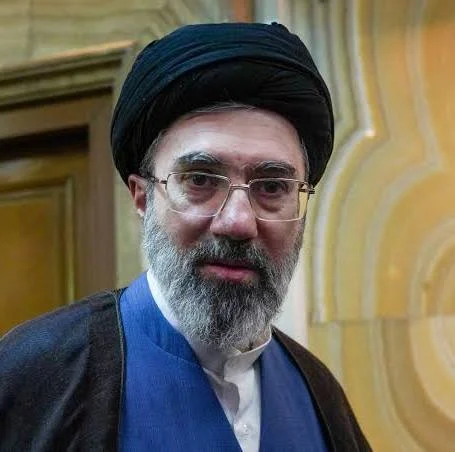
More than four months after Iran’s Islamic Republic named a new supreme leader, the man who holds the country’s most powerful office has yet to appear in public even once. As tens of thousands of mourners filled Tehran’s Grand Mosalla this past week for the funeral of his father, the late Ayatollah Ali Khamenei, Mojtaba Khamenei — the successor whose portrait now hangs across the capital — was nowhere to be seen. His absence, now the subject of open speculation inside and outside Iran, sits at the intersection of two competing explanations: that he is alive but in hiding from a credible assassination threat, or that his condition is more serious than Iranian officials have acknowledged.
The uncertainty traces back to February 28, when a joint U.S.-Israeli operation opened with strikes on Iranian leadership and military sites, killing Ayatollah Khamenei, his wife, and members of his extended family in what Israeli officials later described as a strike on the Islamic Republic’s founding figure of the post-1989 era. Mojtaba Khamenei was reportedly present at the same compound and was wounded in the attack that killed his father. Iran’s Assembly of Experts, the clerical body constitutionally tasked with selecting a new supreme leader, met within days under what multiple outlets described as pressure from the Islamic Revolutionary Guard Corps to resolve the succession quickly given the ongoing military crisis. On March 9, Mojtaba Khamenei, 56, was announced as Iran’s third supreme leader.
He has not been photographed, filmed, or heard from since.
Iranian officials have offered a consistent public explanation: security. Security officials reportedly denied Mojtaba’s request to attend his father’s burial in the holy city of Mashhad, citing fears that any public appearance could make him a target for Israeli strikes. That concern is not abstract. Israeli Defense Minister Israel Katz said in a Hebrew-language statement during the funeral procession that the elder Khamenei “was assassinated by Israel because he set in motion and led the plan to destroy Israel,” and warned that “any Iranian leader” who pursued similar plans “will also be thwarted” — language widely read in Tehran as a direct threat against the son now holding his father’s title.
Washington has gone further than rhetoric. In mid-March, the U.S. State Department’s Rewards for Justice program listed Mojtaba Khamenei among ten senior Iranian officials for whom it is offering up to $10 million for information on their whereabouts, describing them collectively as commanding elements of the Revolutionary Guard that “plan, organize and execute terrorism around the world.” The notice, which also named Supreme National Security Council secretary Ali Larijani, invited tips through encrypted channels and dangled the possibility of relocation for informants — the standard structure of a program more commonly associated with hunting terrorist financiers and fugitive militants than a head of state. Several other men named on that same list, including intelligence minister Esmail Khatib and Larijani himself, have since reportedly been killed in subsequent Israeli and American strikes, underscoring that the bounty was not symbolic.
Layered on top of the security explanation are persistent, unverified reports about Mojtaba’s physical condition. Multiple outlets, citing people close to his circle, have reported that he suffered facial injuries and damage to one or both legs in the February 28 strike, though Tehran has neither confirmed nor addressed those claims directly. A Pentagon assessment cited by at least one outlet concluded that the new supreme leader is likely wounded and disfigured, though that assessment has not been independently corroborated by on-the-record U.S. officials. Iran’s government has not released any photograph, video, or medical statement addressing his condition since the February strike, an unusual silence for a government that has otherwise continued to broadcast extensive funeral coverage, statements from surviving family members, and appearances by the rest of the country’s senior leadership, including President Masoud Pezeshkian, parliament speaker Mohammad Bagher Ghalibaf, and judiciary chief Gholam-Hossein Mohseni-Eje’i.
That contrast has not gone unnoticed inside Iran. Iranian state media broadcast footage of three of the late Khamenei’s other sons — Mostafa, Meysam, and Masoud — visibly emotional as they helped carry their father’s coffin through the Mosalla. Ordinary mourners interviewed by international outlets described a specific unease at the absence of the man now technically leading the country. One Tehran resident in her twenties told a reporter covering the funeral that the country was “no longer the Iran of old, where the leader is publicly present,” and said the sense of continuity that once came from seeing the supreme leader during moments of national crisis was now missing entirely.
The competing theories about Mojtaba’s condition break down roughly three ways. The official Iranian position is that he is alive, functioning, and simply keeping a low profile on the advice of his security detail, consistent with a genuine and well-documented Israeli and American targeting effort. A second, more skeptical reading — advanced mostly in Israeli and Western commentary rather than by any government on the record — holds that his injuries are serious enough that Iran’s clerical and security establishment is managing his public silence as much for image reasons as for safety, projecting continuity through surrogates while he recovers or while the true extent of his incapacitation is worked out behind closed doors. A third, more speculative strain of commentary and social media rumor has questioned whether Mojtaba is dead and being kept nominally “in power” as a legal fiction while Iran’s competing power centers — the IRGC, the Assembly of Experts, and rival clerical factions — negotiate a real succession out of public view. No credible reporting has substantiated that third claim, and Iranian officials have directly denied any suggestion that Mojtaba is deceased, but the total absence of proof-of-life material has left the theory circulating rather than settled.
The stakes of that uncertainty extend beyond Tehran’s internal politics. Iran’s supreme leader holds constitutional authority over the armed forces, foreign policy, and the judiciary, and functions as commander-in-chief of a country still absorbing the aftershocks of a war that killed dozens of its most senior military and political figures within weeks. A leader who cannot be seen, heard, or reliably reached complicates decision-making at precisely the moment Iran’s government says it is weighing further retaliation, pursuing a legal complaint against the United States and Israel over the assassination, and trying to project stability to a population that has lived through mass protests, economic strain, and now an unprecedented leadership vacuum within the same year.
What is verifiable is narrower than what is rumored: Mojtaba Khamenei holds the constitutional title of supreme leader; he has not appeared publicly in over four months; his own government cites credible assassination threats, including an on-record threat from Israel’s defense minister, as the reason; and the United States has placed a substantial bounty on locating him, treating him for intelligence purposes less like a head of state and more like a wanted militant commander. Those facts alone would be extraordinary for any government functioning under normal conditions. For an Islamic Republic whose legitimacy has rested since 1989 on the idea of a visible, publicly present supreme leader delivering guidance during moments of crisis, the prolonged silence of the man now holding that office is, at minimum, a genuine break from precedent — whatever the reason behind it eventually turns out to be.
Until Iran’s government produces verifiable proof of life — a live broadcast, a dated photograph, or a public appearance that can be independently confirmed — the gap between the official explanation and the rumors filling it is likely to persist. That gap matters less for what it says about one man’s whereabouts than for what it reveals about the fragility of a governing system built around the idea that its highest office is, by design, never supposed to be invisible.
— Jose E. Navarro, The Navarro Report / Human-Directed AI Journalism: Research, analysis, and editorial direction by the author. Drafted in partnership with Claude AI (Anthropic).