
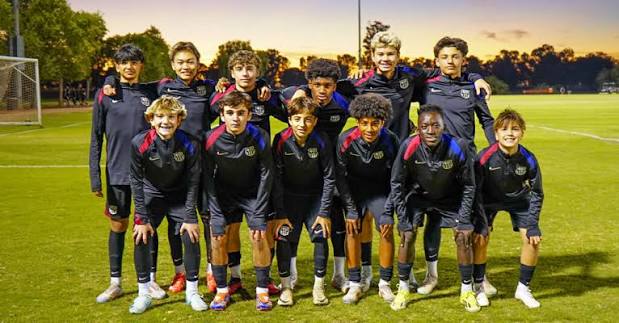
The United States is co-hosting its first World Cup since 1994, and the sport has never had more money, more television coverage, or more youth participants pouring through its turnstiles. Yet a hard question sits underneath all of that growth, one that rarely gets asked directly: of the fifty best players currently active in the world, not a single one is American. Not one came up through a U.S. academy.
The easy explanation is the one most youth soccer critics reach for first: pay-to-play. American families spend an average of $883 a year per child on club fees, travel, and tournament costs just to keep a kid in competitive soccer, with travel expenses alone up 19 percent since before the pandemic. That system, the argument goes, filters talent by family income rather than ability, and it has become the standard critique of American player development.
But look closely at the handful of Americans who have actually broken through to elite European clubs, and a more specific, more solvable story emerges. Weston McKennie, Tyler Adams, Timothy Weah in his formative years, Chris Richards, Ricardo Pepi — nearly every current USMNT starter who developed domestically came up through one of exactly two programs: the New York Red Bulls Academy or the FC Dallas Academy. Both are Major League Soccer “Homegrown” academies. Both are free.
That detail matters more than it might first appear. MLS built these academies specifically as a counterweight to pay-to-play travel soccer, modeling them loosely on the professional club-academy systems used across Europe and South America, where clubs fund youth development as a long-term investment rather than charging families a subscription fee. Tyler Adams, who joined the Red Bulls’ scouting pipeline at age ten and turned pro with the club at sixteen, has been direct about what that structure meant for his career — and he has since personally funded free training fields in his hometown to extend that kind of access to the next generation of kids in the Hudson Valley.
Weston McKennie’s path tells a similar story from a different state. He joined the FC Dallas Academy in 2009 and spent seven years inside a program that has become the most productive Homegrown pipeline in MLS, sending players like McKennie, Richards, Pepi, and others abroad or into professional contracts without ever charging his family a fee. McKennie turned down a college scholarship and a Homegrown contract offer from Dallas itself to sign instead with German club Schalke 04 at eighteen, a decision that eventually carried him to Juventus and a decade of first-team soccer in Europe’s top leagues.
If a free, professionally-run academy model produces disproportionate results, the obvious next question is why it hasn’t scaled beyond a couple of metro areas. The answer is partly structural and partly financial. Running a true Homegrown academy is expensive: full-time coaching staff, dedicated training facilities, a scouting network that can identify talent as young as eight or nine, and a willingness to operate at a financial loss for years before a single player generates transfer revenue. MLS clubs in smaller or newer markets often cannot justify that investment the way a club with the Red Bulls’ global ownership structure or Dallas’s two-decade head start can.
The result is a lopsided map. A talented eight-year-old in the New York metro area or the Dallas–Fort Worth region has a realistic, cost-free path toward elite development if he is identified early enough. A talented eight-year-old in most of the rest of the country does not have that option; his only route into serious competitive soccer runs through a pay-to-play club, with all of the financial gatekeeping that implies.
This unevenness also compounds an access problem that has nothing to do with a family’s ability to pay. Both flagship academies depend on scouts finding players early, often through regional development programs that themselves require some baseline exposure to organized youth soccer to be seen at all. Tyler Adams was fortunate to live close enough to commute — eventually eighty miles round trip — to Red Bulls training. A similarly gifted child two hundred miles further from either hub, in a family with no soccer background to know such a pipeline exists, is simply never found.
U.S. Soccer and MLS have taken some steps to address the gap. Mini-pitch construction programs, timed partly to the 2026 World Cup, have brought small-format courts into urban neighborhoods that previously had little organized soccer infrastructure at all. MLS NEXT, the league’s national development platform, has expanded partnerships with more clubs across more regions since its 2020 launch, aiming to standardize coaching quality outside the two or three cities that have historically dominated player production. Advocates for these programs argue they are a genuine improvement. Critics counter that mini-pitches, often built with harder acrylic surfaces instead of grass, still fall short of replicating the full-field experience wealthier suburban kids take for granted, and that expansion has been slower and thinner than the scale of the problem requires.
There is also a harder truth embedded in the Red Bulls and Dallas success stories that reform advocates rarely address directly: even inside a free academy, some form of privilege still determines who gets discovered. McKennie’s father was a professional player who had already immersed his son in German soccer culture years before FC Dallas found him. Gio Reyna, who came through a similarly structured academy at NYCFC, was scouted in part because his father served as the club’s sporting director. Removing a financial barrier does not automatically remove every other advantage that comes from growing up in a soccer-literate household.
None of this diminishes what the Red Bulls and Dallas programs have proven: that a professionally funded, fee-free academy model can and does produce world-class talent inside the American system, without asking a single family to write a check. The unresolved question is one of national will and investment. Expanding that model to twenty cities instead of two would require MLS clubs, U.S. Soccer, and potentially outside investors to treat youth development the way European federations already do — as a long-term national asset rather than a boutique amenity available only where an ownership group happens to be willing to underwrite it.
The World Cup on American soil this summer has already reopened the conversation about why the country with the world’s deepest sports economy still cannot produce a player who ranks among the global elite. The Red Bulls and FC Dallas academies suggest the technical answer to that question is already sitting inside the American system. The remaining question is whether the rest of the country is willing to fund it.
There is reason to think the answer could be yes, at least in pockets. A few other MLS clubs have begun investing more heavily in their own Homegrown pipelines in recent years, hiring full-time academy directors and building dedicated training centers rather than treating youth development as an afterthought to the first team. Whether those investments produce a McKennie or an Adams a decade from now will depend less on ambition than on sustained financial commitment through years in which an academy generates no revenue at all.
For a league still building its financial footing relative to Europe’s giants, that kind of patient investment is a harder sell to ownership groups focused on near-term competitiveness. But the alternative, as this summer’s World Cup roster makes clear, is continuing to rely on two cities to produce nearly all of the country’s next generation of elite talent — a bottleneck that leaves an enormous amount of potential simply unscouted, regardless of how much a family might have been willing to spend to be found.
— Jose E. Navarro, The Navarro Report / Human-Directed AI Journalism: Research, analysis, and editorial direction by the author. Drafted in partnership with Claude AI (Anthropic).